Beyond Basic Alignment
Orthodontic treatment operates in distinct mechanical phases. When a patient first receives fixed appliances, the primary clinical objective is leveling and aligning the dental arches. Flexible nickel-titanium (NiTi) archwires thread through the brackets to unravel crowding, correct rotations, and bring all crowns to a uniform vertical plane.
However, achieving a straight row of teeth is only the first phase of treatment. Once the teeth are aligned, orthodontists must address the horizontal dimension: closing structural gaps, consolidating the arch perimeter, and ensuring the upper and lower teeth interlock correctly.
This critical phase of space closure relies heavily on a specialized elastomeric tool known as power chain braces.
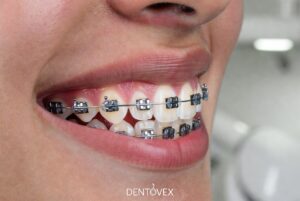
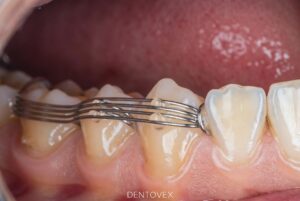
Instead of standard individual rubber ligatures (the small O-rings that hold the wire to each bracket), a power chain is a continuous, linked strip of medical-grade polyurethane. When stretched across multiple brackets, this material exerts a constant, uniform contractile force that physically drags teeth along the archwire toward each other.
At Dentovex, we prioritize patient education regarding the physical forces applied to their teeth. In this master guide, we deconstruct the materials science behind elastomeric power chains, evaluate their clinical indications for space closure, detail the cellular response in the periodontal ligament, and provide an evidence-based protocol for managing the associated tension.
1. The Materials Science of Elastomeric Force Delivery
To appreciate how power chains manipulate bone structure, one must understand their composition. Power chains are manufactured from specialized synthetic elastomeric polymers, primarily polyurethane.
Polyurethane is chosen for its specific viscoelastic properties: it can be stretched significantly beyond its resting length while retaining a high elastic memory—the inherent physical desire to snap back to its original shape.
When an orthodontist stretches a power chain across a span of teeth, the mechanical energy stored in the stretched polymer transfers directly into the brackets.
Force Decay over Time
Unlike the rigid mechanical force applied by a surgical steel jackscrew in a palatal expander, elastomeric force is not infinite. Polyurethane undergoes a phenomenon known as force decay.
- Initial Load: Upon placement, the chain delivers 100% of its intended force.
- 24-Hour Drop: Within the first day, the material absorbs salivary moisture and experiences thermal expansion from body heat, losing up to 40% of its initial force.
- Sustained Plateau: For the next three to four weeks, the chain settles into a constant, lighter biological force that safely guides tooth movement.
This decay is a deliberate safety mechanism. Continuous, excessively heavy forces can cause root resorption (the blunting of tooth roots). The gradual decay of the power chain ensures that the periodontal tissues receive adequate blood flow to facilitate healthy bone remodeling.
2. Cellular Biomechanics: How Teeth Actually Move
Understanding the biological reaction to a power chain requires looking beneath the gum line at the Periodontal Ligament (PDL). The PDL is the fibrous hammock that suspends the tooth root within the alveolar bone.
When a power chain pulls two teeth together, it compresses the PDL on the leading edge (the direction the tooth is moving) and stretches the PDL on the trailing edge.
- Pressure Side (Osteoclast Activity): The compression cuts off localized blood supply, triggering an inflammatory response. The body deploys osteoclasts—specialized cells that literally dissolve and break down the bone ahead of the moving tooth to clear a path.
- Tension Side (Osteoblast Activity): On the opposite side of the root, the stretched PDL fibers signal osteoblasts to lay down fresh, new bone matrix, filling in the space the tooth left behind.
Clinical Insight: The dull ache you feel after receiving a power chain is not just mechanical tension; it is the physical sensation of localized cellular inflammation within the PDL. This inflammation is a strict biological requirement for osteoclast activation and tooth movement.
3. Clinical Indications: When Are Power Chains Applied?
Orthodontists do not use power chains immediately. They are typically introduced midway through treatment, once the flexible initial wires are replaced with rigid stainless steel working wires. Using a power chain on a highly flexible wire would simply bow the wire and tip the teeth inward rather than moving them laterally.
Primary clinical scenarios requiring power chains include:
- Extraction Space Closure: If premolars were extracted to resolve severe crowding, power chains are the primary mechanism used to slide the canine and incisor teeth backward along the archwire to seal the extraction sites.
- Generalized Diastemas: Patients with naturally small teeth or wide dental arches often present with multiple gaps (diastemas). A continuous chain consolidates these spaces, pulling all teeth into a tight, uniform block.
- Midline Correction: If the upper and lower dental midlines do not align, an orthodontist can run a power chain on one specific side of the arch to shift the entire block of anterior teeth toward the center.
- Derotation of Stubborn Teeth: A power chain can be linked to a specific offset button on a rotated tooth, applying rotational torque to spin the tooth into its correct axis.
4. Architectural Variants: Types of Power Chains
Because teeth vary in width and the required force vectors differ by malocclusion, braces manufacturers engineer power chains in three distinct inter-bracket spacing configurations:
| Chain Configuration | Structural Design | Primary Clinical Application |
| Continuous (Closed) | No connecting space between the individual O-rings. | Used for smaller teeth (lower incisors) or when strong, immediate consolidation of multiple teeth is required without gaps. |
| Short (Open) | A small length of polyurethane connects each O-ring. | The standard choice for average-sized teeth (premolars/canines) to maintain consistent, moderate space-closing tension. |
| Long (Wide) | Extended connection spans between O-rings. | Utilized when brackets are spaced widely apart, or to bypass a specific tooth entirely while connecting the adjacent teeth. |
5. The Clinical Procedure: Placement and Activation
Patients often wonder exactly what happens during an adjustment visit when space closure begins. The transition to elastomeric chain mechanics follows a highly structured clinical sequence:
1.1. Archwire De-Ligation:Removal of standard ligatures.
The clinical assistant removes all existing individual O-rings or opens the self-ligating bracket doors to free the archwire. The teeth are thoroughly cleaned of any trapped plaque.
2.2. Working Wire Verification:Transition to steel.
The orthodontist ensures a sufficiently rigid stainless steel or TMA (Titanium Molybdenum Alloy) wire is in place. This rigid track prevents the power chain’s tension from bowing the arch vertically.
3.3. Chain Selection & Sizing:Measuring the span.
The specialist measures the target span (e.g., from the upper right molar to the upper left molar) and cuts the appropriate length of Continuous, Short, or Long chain from the sterile spool.
4.4. Engagement & Stretching:Applying the mechanical load.
Using specialized Mathieu pliers, the orthodontist stretches the first loop of the chain over the anchor molar bracket, subsequently stretching and locking each successive loop over the remaining brackets across the arch.
5.5. Capillary Assessment:Final check.
The orthodontist checks the gingival tissue for blanching (turning white). A slight blanching that returns to pink within seconds is normal; prolonged blanching indicates excessive force that must be adjusted.
6. Pain Management and Pharmacological Considerations
Because power chains apply simultaneous force to multiple teeth, the initial inflammatory response in the PDL is notably stronger than during a standard wire change.
Tension typically peaks within 24 to 48 hours following placement and gradually subsides over 3 to 5 days.
The Problem with NSAIDs in Orthodontics
When patients experience orthodontic discomfort, their first instinct is often to take Non-Steroidal Anti-Inflammatory Drugs (NSAIDs) like Ibuprofen (Advil) or Naproxen. However, clinical evidence suggests this is counterproductive to treatment.
NSAIDs work by inhibiting the synthesis of prostaglandins—the exact inflammatory compounds that activate osteoclasts to dissolve bone. By suppressing prostaglandins, NSAIDs actively slow down tooth movement.
- The Recommended Protocol: For orthodontic pain management, Acetaminophen (Tylenol) is the clinically preferred analgesic. Acetaminophen acts on the central nervous system to block pain receptors but does not suppress the peripheral tissue inflammation required for bone remodeling.
7. Aesthetic Maintenance: Diet and Discoloration
One of the most common patient frustrations with power chains is material discoloration. Because polyurethane is microporous, it easily absorbs dark chromogens from food and beverages.
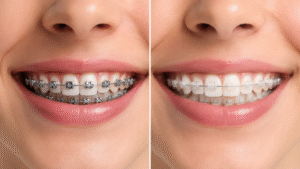
This is particularly critical for adult patients utilizing transparent teeth braces (ceramic or sapphire brackets). A stained power chain will instantly compromise the aesthetic invisibility of the ceramic hardware.
To prevent premature yellowing or staining of clear and silver chains, patients must strictly avoid:
- Curry and Turmeric: The curcumin in turmeric binds instantly to polyurethane, turning clear chains bright yellow within seconds.
- Dark Berries and Beets: High concentrations of natural anthocyanin pigments.
- Coffee, Tea, and Red Wine: Heavy tannins easily infiltrate the elastomeric pores.
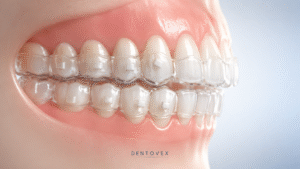
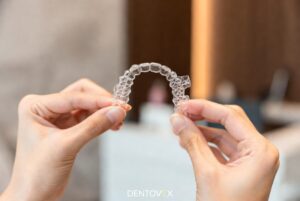
If aesthetics are a paramount concern and dietary restrictions are difficult to maintain, patients may discuss transitioning from fixed ceramic appliances to invisalign clear aligners, which utilize removable trays rather than porous elastomeric chains for space closure.
Navigating the Final Stretch of Treatment
The introduction of power chain braces marks a definitive turning point in your orthodontic journey. It signals that the foundational alignment is complete and the detailed architectural work of closing gaps and perfecting the bite has begun.
While the initial mechanical tension demands a few days of adaptation, the rapid visual progress of spaces closing is often the most highly rewarding phase of treatment for patients. By maintaining strict oral hygiene to protect the gums around the chain and adhering to clinical adjustment schedules, you ensure that the biomechanical forces work efficiently, bringing you rapidly closer to your final retention phase.
Disclaimer: Orthodontic biomechanics vary based on individual skeletal and dental anatomy. Always consult with a licensed orthodontic specialist to understand the specific force mechanisms utilized in your personalized treatment plan.

No responses yet