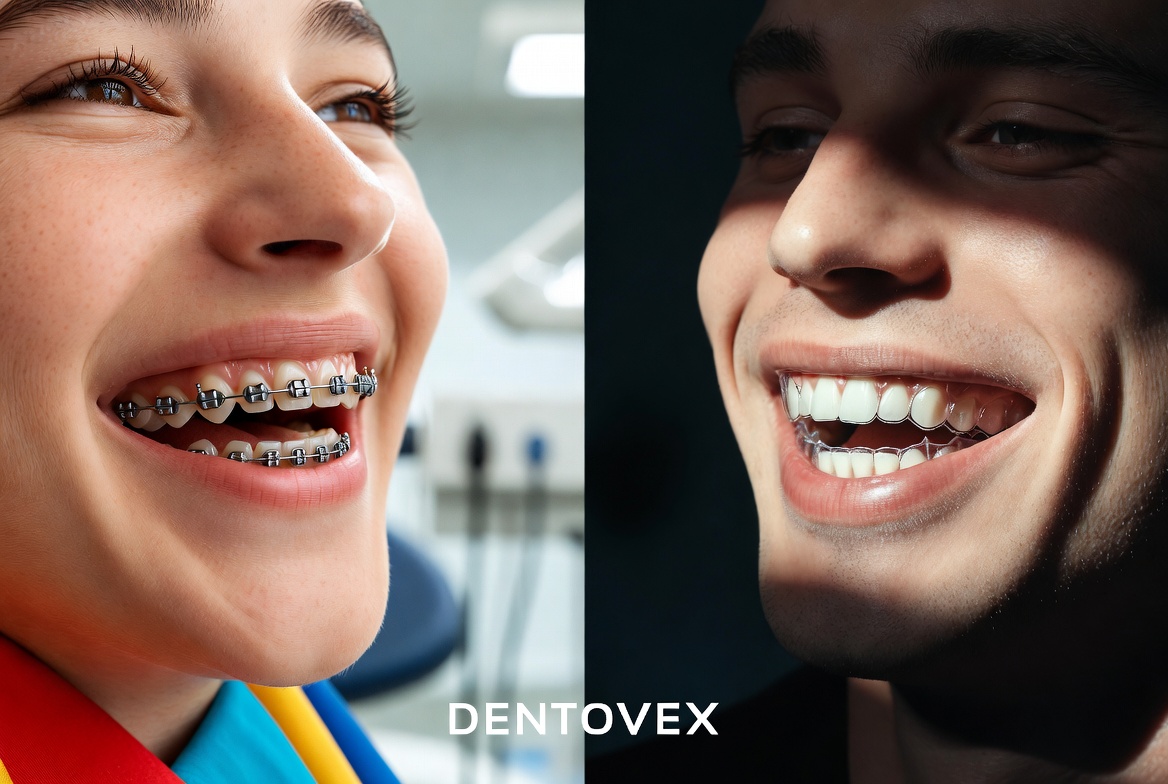
Beyond the Marketing Brochures
If you’ve spent more than five minutes researching how to fix your smile, you’ve seen the glossy ads. On one side, you have Invisalign: the “invisible,” high-tech, lifestyle-friendly choice. On the other, traditional braces: the “tried and true,” powerful, but often dreaded metal brackets.
Most blogs give you a boring list of pros and cons. At Dentovex, we’re skipping the fluff. We’ve seen patients thrive with both, and we’ve seen patients regret both. Choosing between aligners and braces isn’t just about aesthetics; it’s about your discipline, your pain tolerance, and how much you enjoy eating popcorn.
Here is the unfiltered, clinical, and social breakdown of the Invisalign vs. Braces battle.
1. The “Invisibility” Myth: They Aren’t Actually Invisible
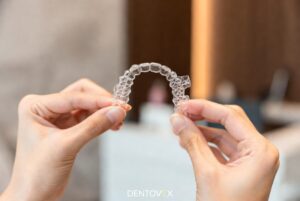
Invisalign’s biggest selling point is that no one will know you’re wearing them. That’s a half-truth.
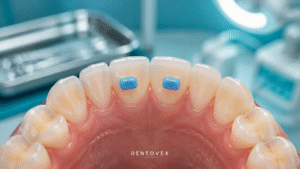
To move teeth effectively, Invisalign often requires “attachments”—small, tooth-colored bumps of composite resin glued to your teeth. When the trays are off, these feel like sandpaper against your lips. When the trays are on, the plastic has a certain “glint” under office lights.
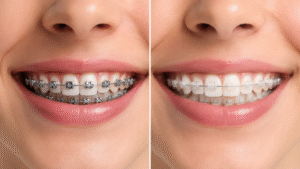
- The Reality Check: While far more discreet than metal, people close to you will notice. However, in professional settings, aligners win every single time. Braces, even the ceramic “clear” ones, still scream “I’m in treatment.”
2. The Lifestyle Tax: Food vs. Discipline
This is where the two systems diverge completely.
The Freedom of Invisalign (With a Catch)
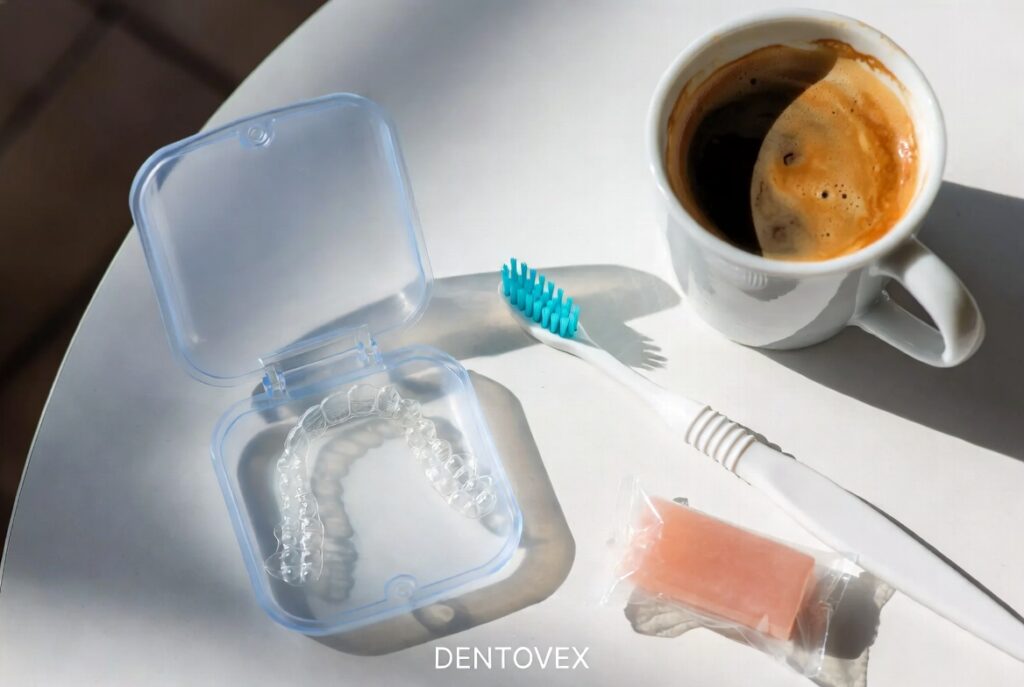
With aligners, you can eat anything. Steak? Corn on the cob? Sticky candy? No problem—just take the trays out.
The Catch: You must wear them for 22 hours a day. If you are the type of person who forgets their keys or loves to sip coffee for three hours every morning, Invisalign will be a disaster. Every hour the tray is out, your treatment is stalling.
The Restriction of Braces
Braces are “set it and forget it.” They are working 24/7. You don’t have to remember to put them back in.
The Trade-off: You will develop a deep, personal hatred for spinach, crusty bread, and anything with seeds. Cleaning your teeth after a meal with braces feels like a part-time job.
3. The Pain Factor: “Dull Ache” vs. “Sharp Pokes”
Let’s be honest: moving bone through bone hurts. There is no “painless” orthodontics.
- Invisalign Pain: It feels like a constant, heavy pressure across your entire arch every time you put in a new tray. The first 48 hours of a new tray are usually spent on a “soft food diet.”
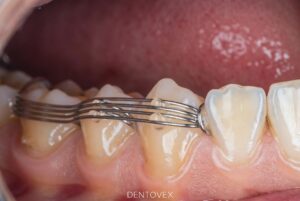
- Braces Pain: The pressure is more localized. However, the real pain comes from the hardware. A poking wire or a sharp bracket can turn your inner cheek into a battlefield. You will become best friends with orthodontic wax.
4. Clinical Speed: Which One Finishes First?
There is a common belief that Invisalign is slower. In 2026, this is mostly false.
For simple crowding or closing small gaps, Invisalign is often faster because it can move individual teeth simultaneously. However, for complex “root movements” (like pulling an impacted tooth or fixing a severe bite), traditional braces still hold the crown. Braces provide the 3D leverage that a piece of plastic sometimes struggles to achieve.
5. The “Smell” Factor (The Thing No One Talks About)
If you don’t clean your aligners properly, they will smell. It’s a biological fact. Saliva and bacteria get trapped between the plastic and your teeth.
With braces, the “smell” issue is usually linked to poor flossing between brackets. Both require a level of hygiene that most people aren’t used to. If you’re choosing Invisalign because you think it’s “cleaner,” remember: you are essentially wearing a plastic bag over your teeth for 22 hours a day.
6. The Financial Bottom Line (High CPC Insight)
Historically, Invisalign was the “luxury” option. Today, the gap has closed significantly.
| Feature | Traditional Braces | Invisalign / Clear Aligners |
| Estimated Cost | $3,000 – $6,000 | $3,500 – $7,000 |
| Insurance Coverage | Usually covered (standard) | Increasingly covered as “standard” |
| Emergency Visits | Higher (broken wires/brackets) | Lower (lost trays/attachments) |
Pro Tip: Check your insurance for “Orthodontic Lifetime Maximum.” Most plans don’t care which system you choose; they just pay a flat fee toward the total.
Conclusion: Which One Should You Choose?
The decision boils down to one question: How much do you trust yourself?
- Choose Invisalign if: You are disciplined, you have a high-profile job, and you are willing to brush your teeth five times a day.
- Choose Braces if: You want to eat without worrying about a timer, you tend to lose things, and you want the most “efficient” move for a complex bite.
At the end of the day, both tools can give you a perfect smile. The “best” one is the one you will actually stick with until the end.
No responses yet