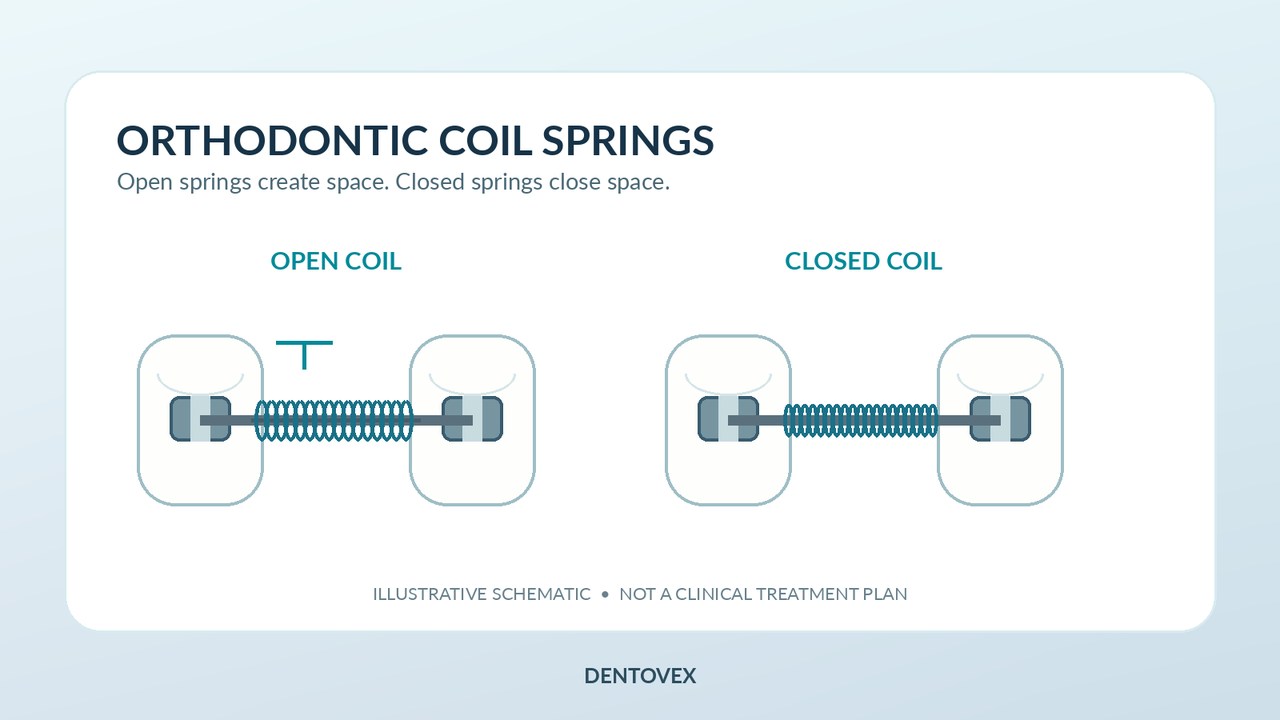
An orthodontic coil spring is a small metal spring that an orthodontist attaches to the braces system to help manage space between teeth. An open-coil spring is compressed to help create or maintain room; a closed-coil spring is stretched between attachment points to help close a gap. Both are clinician-controlled appliances. Do not pull, cut, tighten, or remove a spring yourself.
If you notice a shiny metal spiral threaded along your braces wire, it can look more complicated than the familiar colored ties. Some patients are told the spring will make space for a tooth that has not come into position. Others hear that it will close a gap. Both explanations can be correct, because the spring’s effect depends on its design and how the orthodontist attaches it.
This guide focuses on the questions a patient actually needs answered: what the spring is doing, what discomfort may be expected, how to clean around it, what to do if it comes loose, and what clinical research can and cannot tell us about treatment speed.
What Is a Coil Spring in Orthodontics?
A coil spring is a small spiral of metal used to deliver controlled orthodontic force. Nickel-titanium (NiTi) alloys are commonly used because of their elastic behavior, although specific materials and designs vary. Unlike the removable rubber bands that a patient may hook between upper and lower teeth, coil springs are generally fitted and adjusted by the orthodontist.
The spring works as one component of a larger appliance. Brackets, an archwire, and anchorage teeth help direct the force. This matters: a spring does not independently know where to move a tooth, and the orthodontist must consider neighboring teeth, roots, available bone support, and the planned final bite.
For context, Dentovex’s braces treatment overview explains how brackets and wires guide tooth movement. The American Association of Orthodontists (AAO) also describes braces as a system that uses controlled pressure over time.
Open-Coil vs. Closed-Coil Springs: What Is the Difference?
The terms describe how the spring is used, not simply how it looks in a photograph.
| Feature | Open-coil spring | Closed-coil spring |
|---|---|---|
| Main mechanical action | Compressed to push its ends apart | Stretched to pull its ends toward one another |
| Typical purpose | Create or preserve space | Help close an existing gap |
| Common placement | Around a section of archwire between neighboring brackets | Between orthodontic hooks or other attachment points |
| Patient adjustment | None | None |
| What to report | Displacement, wire irritation, sudden change | Detachment, sharp end, unexpected breakage |
Open-coil springs may be used when a tooth needs room to align or erupt. Imagine two teeth that have drifted too close together: the orthodontist may use a compressed spring to help open the space between them. The amount and direction of movement depend on the surrounding mechanics.
Closed-coil springs are commonly used in space closure, including some extraction cases. The spring is stretched between attachment points and tends to shorten, providing a pulling force. It is not interchangeable with an open-coil spring simply because both are metal spirals.
Is a coil spring the same as a power chain?
No. A power chain is a linked elastomeric material fitted across brackets. A closed-coil spring is a metal spring. Both may be used for certain space-closing mechanics, but their material behavior, attachment, and force delivery differ. Neither is automatically the better option for every patient.
Is it the same as orthodontic rubber bands?
No. The rubber bands for braces guide explains intermaxillary elastics, which often connect upper and lower teeth and may be replaced by the patient as directed. Coil springs are normally part of the fixed appliance and should not be adjusted at home.
Why Would an Orthodontist Put a Spring on My Braces?
There are several possible reasons. The exact purpose should be stated in your treatment plan rather than guessed from the spring’s appearance.
Making space for a crowded or blocked-out tooth
An open-coil spring can help establish room along the arch for a tooth that is rotated, displaced, or waiting to be brought into alignment. Creating space is only one stage; the orthodontist may then use different mechanics to move the tooth into that space. A spring does not guarantee that a tooth will erupt on its own.
Closing an extraction or other treatment gap
A closed-coil spring may help bring teeth toward one another along a controlled path. The orthodontist needs to manage how the teeth move, not just whether the visible gap becomes smaller. Root position, anchorage, and bite relationships remain important.
Controlling the pace and direction of movement
Orthodontists choose springs with different force characteristics and lengths. It would be misleading to assign a universal number of days or a universal amount of force to every patient. The same spring can behave differently depending on how much it is compressed or stretched and on the surrounding appliance.
What Does the Research Say About Speed?
Research supports the clinical use of coil springs, but it does not establish that every spring makes braces treatment faster.
A 2021 single-center randomized clinical trial compared an open-coil technique with a conventional approach for anterior crowding. The study included 62 patients and reported no statistically significant difference in alignment duration between the methods. That result is useful because it challenges the simplistic claim that an open-coil spring always speeds up treatment. It does not prove that the two techniques are identical in every clinical situation.
Older clinical studies of closed nickel-titanium coil springs compared space closure with elastic modules. One 1993 comparative study reported more consistent and faster space closure with the tested NiTi spring system in a small sample. A 1998 follow-up clinical study also found differences among the tested spring-force groups and elastic modules. These results concern specific extraction-space mechanics and do not establish a universal treatment timeline or a recommended force for an individual patient.
The practical takeaway: springs are tools for a particular mechanical job. The overall treatment outcome depends on diagnosis, periodontal health, anchorage, appointment timing, and the orthodontist’s plan—not on a single component alone.
Do Coil Springs Hurt?
Some patients notice pressure or soreness when a spring is first placed or adjusted. Tooth movement involves changes in the tissues around the roots, so tenderness during a period of active movement is possible. The degree and duration vary. It is not possible to predict from a blog post how much discomfort a specific patient should have.
Discomfort from a spring can also be mechanical, such as a rough end rubbing the cheek or a displaced component catching the lip. That is different from pressure-related tooth tenderness and may require an appliance adjustment.
For mild tenderness, softer foods and following your orthodontist’s usual comfort advice may help. Do not change the spring’s position or use a tool to compress it. If pain is severe, worsening, associated with swelling, or prevents normal eating or sleeping, contact your orthodontist or dentist for assessment.
Eating With Coil Springs
The same general food precautions used with fixed braces still apply. The AAO’s living-with-braces guidance recommends avoiding foods that are very hard, sticky, or chewy when they could damage the appliance.
Choose softer foods if teeth are tender after an adjustment. Cut firm foods into small pieces instead of biting into them with the front teeth. Avoid chewing on pens, ice, and other hard objects. If food catches in the spring, rinse and clean gently rather than tugging at the coil with a fingernail or sharp object.
A spring may sit close to a bracket, band, or wire bend. The safest advice is to follow the orthodontist’s food restrictions for the whole appliance, not to invent a separate diet based on the spring alone.
How to Clean Around a Coil Spring
Braces can create additional plaque-retentive areas. A spring adds another narrow surface that deserves attention. Cleaning is important for gum health and to reduce the chance of decalcification and cavities.
Use a soft toothbrush and fluoride toothpaste as your dental team recommends. Angle the brush to clean around the gumline and on both sides of the wire. A suitable interdental brush may help remove debris near the spring, but it should be used gently and only where it fits without force. Clean between teeth with the flossing method recommended for your particular braces setup.
The AAO’s oral-hygiene guidance explains why cleaning between teeth matters during orthodontic treatment. Do not slide the spring along the wire to reach underneath it; ask the orthodontist to demonstrate the safest way to clean your exact appliance.
What If a Coil Spring Pops Off, Breaks, or Starts Poking?
An appliance problem can be inconvenient without necessarily being a medical emergency. The correct response depends on whether the component is still attached, is sharp, or is creating a risk of swallowing or injury.
| What you notice | What to do | What to avoid |
|---|---|---|
| Mild rubbing without breakage | Call the orthodontist for advice; orthodontic wax may help cover an accessible sharp area temporarily | Forcing the spring into a new position |
| Spring appears displaced or no longer doing its job | Contact the orthodontic office and describe or photograph the problem | Stretching, cutting, or reattaching it yourself |
| Loose piece has come out of the mouth | Keep the piece safely if possible and inform the orthodontist | Trying to put it back on |
| Sudden severe pain, bleeding, swelling, or injury | Seek prompt professional assessment | Waiting for a routine adjustment without calling |
| Trouble breathing or swallowing, significant trauma | Seek emergency medical care | Home repair attempts |
The AAO emergency guide distinguishes common appliance problems from true medical or dental emergencies. It recommends contacting the orthodontist when a component is loose or broken. This article deliberately does not give instructions for cutting springs or modifying the archwire at home.
How Long Do You Wear Coil Springs?
There is no standard wear period that applies to every patient. The spring may be used for part of treatment, replaced during adjustments, or removed once its purpose has been achieved. An open-coil spring may be used until adequate space has been created; a closed-coil spring may be used while a planned gap is closing. Those are descriptions of treatment goals, not predictions about the calendar.
Ask your orthodontist what milestone they are monitoring. The answer may be more useful than an estimated number of weeks: for example, whether there is enough room for a displaced tooth, whether the roots are being controlled during space closure, or whether the bite needs further adjustment.
Questions Worth Asking at Your Next Adjustment
- Is this an open-coil or closed-coil spring, and what is its specific purpose in my case?
- Which teeth are expected to move, and which teeth provide anchorage?
- What changes should I expect to see before the spring is removed?
- How should I brush around the spring without moving it?
- What should I do if it catches my cheek or becomes loose after hours?
- Does the spring affect my next appointment or elastic-wear instructions?
These questions help turn an unfamiliar piece of hardware into an understandable part of your treatment plan.
Frequently Asked Questions
Are coil springs faster than power chains?
Not universally. Some closed-coil systems performed better than elastic modules in specific clinical studies, but treatment speed depends on the type of space, mechanics, and individual circumstances. An open-coil randomized trial did not find a significant speed advantage in the studied crowding cases.
Can I push my coil spring back into place?
Do not attempt to reposition or compress a spring yourself. Call your orthodontist for instructions. The spring is part of a controlled force system.
Is a coil spring supposed to move around?
Some visible movement of components may be possible depending on the design, but a new shift, looseness, sharp edge, or change in fit should be reported. Only your orthodontist can judge whether the appliance is functioning correctly.
Can I use orthodontic wax on a spring?
Wax may sometimes temporarily reduce irritation from an accessible rough area, but ask your orthodontist for guidance and do not cover a broken part in a way that hides a worsening problem.
Will the spring create a gap between my teeth?
An open-coil spring may be used intentionally to create room. A closed-coil spring is more often used to close space. Your clinician can explain which teeth should move and why.
The Bottom Line
Coil springs are precise orthodontic tools, not patient-adjustable accessories. An open-coil spring generally helps create or maintain space, while a closed-coil spring generally helps close it. The important questions are what the spring is meant to achieve, how to keep the area clean, and when to report a problem. Avoid any home adjustment, and ask your orthodontist to explain the mechanics of your own treatment.
Editorial note: This educational article has not been medically reviewed. It does not provide instructions for adjusting orthodontic forces or replacing components. Diagnosis, force selection, and appliance repairs must be handled by a licensed clinician.
References and further reading
- Aminian et al. (2021) — Open-coil spring vs. conventional alignment: randomized clinical trial
- Samuels et al. (1993) — NiTi coil spring vs. elastic module for space closure
- Samuels et al. (1998) — Clinical comparison of coil spring force groups and elastic module
- American Association of Orthodontists — What is an orthodontic emergency?
- American Association of Orthodontists — Living with braces
No responses yet