The Physics of Hidden Orthodontic Movement
Orthodontic patients frequently search for treatment options that offer complete discretion without compromising clinical control. While clear aligners and ceramic brackets have gained popularity, only one appliance system guarantees total invisibility throughout the entire course of active treatment: lingual braces. By bonding customized bracket bases directly to the lingual (inner) surfaces of the teeth, this approach keeps all archwires and attachments entirely hidden from external view.
Lingual orthodontics is widely recognized as one of the most technologically demanding disciplines in modern dental practice. Unlike standard labial braces, which sit on the relatively predictable outer surfaces of enamel, lingual appliances must account for extreme anatomical variation. The inner palatal and lingual surfaces of human teeth present sharp morphologic differences, variable ridge heights, and steep slopes. Consequently, successful lingual alignment relies heavily on advanced 3D intraoral scanning, custom CAD/CAM bracket design, and indirect laboratory bonding.
At Dentovex, our clinical team designs custom lingual treatment plans tailored to the exact internal geometry of your dentition. In this comprehensive guide, we explore the biomechanics of behind-the-teeth alignment, compare lingual systems to alternative cosmetic options, address speech adaptation protocols, and outline maintenance strategies for long-term stability.
1. Biomechanical Distinctions: How Lingual Alignment Operates
Moving teeth from the inner surface changes the physical mechanics of force application due to the bracket’s proximity to the tooth’s center of resistance.
Reduced Interbracket Distance and Archwire Stiffness
The inner perimeter of a dental arch is significantly shorter than its outer perimeter. As a result, lingual brackets are positioned much closer to one another than standard outer brackets. This reduced interbracket distance increases the stiffness of the connecting archwire. To compensate for this mechanical constraint, orthodontists use highly flexible, custom-shaped nickel-titanium (NiTi) archwires that deliver light, continuous forces without causing excessive discomfort or tissue strain.
Efficient Deep Bite Correction
Lingual appliances offer a distinct biomechanical advantage when correcting deep overbites. Upper lingual brackets are typically engineered with integrated bite blocks or ramps. When the patient closes their mouth, the lower front teeth rest directly on these built-in platforms. This contact opens the bite vertically, dis-occludes the back molars, and enables rapid leveling of the lower arch while preventing upper teeth from knocking off lower hardware.
Direct Point of Force Application
Because forces are applied closer to the tooth’s center of resistance on the palatal side, certain movements—such as anterior tooth retraction and vertical intrusion—can be executed with exceptional biomechanical efficiency.
2. Comparing Lingual Systems with Alternative Aesthetic Options
Selecting the right aesthetic treatment depends on your specific bite complexity, daily routine, and personal goals. The table below outlines how lingual braces compare with other popular orthodontic choices:
| Appliance Parameter | Lingual Braces | Ceramic (Clear) Braces | Clear Aligners (Invisalign) |
| Visual Invisibility | 100% Hidden behind the teeth. | Highly subtle, but brackets and wires remain visible up close. | Nearly invisible clear plastic trays. |
| Customization Level | 100% Custom CAD/CAM gold or cobalt-chromium alloy bases. | Standardized bracket sizes with varied base thickness. | Fully custom 3D-printed thermoplastic aligner series. |
| Wear Compliance | Fixed appliance; operates continuously 24 hours a day. | Fixed appliance; operates continuously 24 hours a day. | Removable; requires strict 22-hour daily wear discipline. |
| Complex Movement Control | Superior control over root torque, rotation, and intrusion. | Excellent control over complex rotations and vertical shifts. | Moderate control; severe rotations may require auxiliary attachments. |
| Speech Adaptation Period | Typically 1 to 3 weeks for tongue muscle memory adjustment. | Minimal impact on speech articulation. | Minimal impact on speech articulation. |
3. The Custom Manufacturing Process: CAD/CAM Integration
Because human teeth display complex inner anatomy, pre-manufactured stock brackets cannot be bonded directly to lingual enamel without causing severe fit discrepancies. Achieving precise tooth movement requires a fully customized fabrication process:
1. 3D Digital Scanning: High-resolution optical intraoral impression of arches.
               │
               ▼
2. Digital Setup: Computer-guided positioning of teeth into ideal occlusion.
               │
               ▼
3. CAD/CAM Milling: Custom bracket bases engineered to match lingual enamel contours.
               │
               ▼
4. Robotically Bent Wires: Archwires shaped by robotic arms to match custom slot paths.
               │
               ▼
5. Indirect Bonding Tray: Brackets placed in a precision transfer tray for simultaneous placement.
- High-Resolution Digital Impressions: The process begins with an intraoral 3D scan of your upper and lower dental arches, capturing exact palatal slopes and crown anatomy.
- Virtual Diagnostic Setup: Using specialized software, the clinician moves the digital teeth into their ideal aesthetic and functional occlusion.
- CAD/CAM Bracket Fabrication: Custom bracket bases are engineered to fit flush against the lingual enamel of each individual tooth. These bases are often cast in gold alloy due to its biocompatibility, precise detail reproduction, and low profile.
- Robotic Archwire Bending: Because human hands cannot bend archwires with the microscopic precision required for lingual slot geometries, robotic arms bend the custom archwires based on digital treatment parameters.
- Indirect Bonding Protocol: In the laboratory, the custom brackets are set into a silicone transfer tray. This tray allows the clinician to bond the entire set of brackets to your teeth simultaneously with exact accuracy.
4. The Clinical Workflow for Lingual Treatment
Undergoing lingual orthodontic treatment follows a structured, multi-step clinical progression designed to ensure safety and precision:
1.1. Comprehensive Examination & 3D Imaging:Evaluating internal anatomy and bone support.
High-resolution CBCT scans and intraoral digital impressions are taken to analyze root angles, bone support, and palatal depth.
2.2. Digital Setup & Indirect Tray Fabrication:Custom laboratory fabrication.
Your custom bracket bases and robotic archwires are milled in a specialized laboratory using CAD/CAM technology based on your personal treatment plan.
3.3. Indirect Bonding Session:Precision bracket placement.
Enamel surfaces are prepared and conditioned. The custom silicone transfer tray is placed over the arch, bonding all lingual brackets into position in a single step.
4.4. Custom Wire Insertion & Elastic Mechanics:Archwire engagement and active movement.
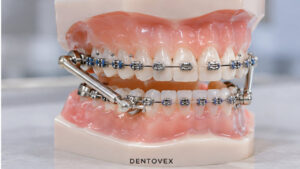
Your initial flexible custom archwire is seated into the bracket slots. If bite correction is needed, intermaxillary rubber bands for braces are attached to designated hooks.
5.5. Final Debonding & Custom Retention:Preserving behind-the-teeth results.
Once alignment is complete, the brackets are removed safely. Custom fixed bonded lingual wires and clear orthodontic retainers are fitted immediately to maintain your results.
5. Adapting to Lingual Braces: Speech, Comfort, and Hygiene
Because lingual appliances occupy space near the palate and tongue, patients go through an initial adjustment phase. Understanding what to expect helps ensure a smooth transition.
Speech Adaptation
Pronouncing certain sounds—particularly sibilants such as “s”, “z”, and “th”—requires the tip of the tongue to make contact with the inner surfaces of the upper front teeth. When lingual brackets are first placed, you may notice a slight lisp. For most patients, speech returns to normal within 7 to 21 days as the tongue adapts to the new contours. Reading aloud for 10 to 15 minutes a day during the first week can help speed up this adjustment process.
Managing Soft Tissue Comfort
During the first few days of treatment, the sides of the tongue may feel sensitive as they rest against the new hardware. Applying medical-grade orthodontic wax or silicone covers over prominent bracket edges provides immediate relief while the delicate oral tissue forms a natural tolerance.
Oral Hygiene Maintenance
Maintaining excellent oral hygiene is essential during any orthodontic treatment. Because lingual brackets are located out of direct sight, specialized cleaning tools are highly recommended:
- Water Flossers: High-pressure water irrigators effectively flush out food particles trapped around inner bracket bases and beneath custom archwires.
- Interdental Brushes: Small, angled proxy brushes help clean vertical bracket borders and areas between the teeth where standard toothbrush bristles cannot reach.
- Compact Electric Toothbrush Heads: Small, oscillating brush heads allow for precise cleaning along the narrow inner curves of the dental arch.
6. Financial Considerations and Treatment Values
Lingual orthodontics requires a higher investment than traditional metal or ceramic appliances. This price difference stems from several factors:
- Individualized Manufacturing: Every bracket base and archwire is custom-milled for a single patient using advanced CAD/CAM technology and specialized materials like gold alloy.
- Laboratory Engineering: Specialized technicians spend hours designing the digital setup and transfer trays required for accurate indirect bonding.
- Clinical Expertise: Placing and adjusting lingual appliances requires advanced post-graduate clinical training and specialized instruments.
Detailed financial breakdowns and flexible payment structures can be reviewed in our comprehensive guide on the cost of braces.
Conclusion: Completely Hidden, Precision-Driven Alignment
Lingual braces offer an exceptional blend of complete aesthetic invisibility and advanced biomechanical control. By utilizing custom CAD/CAM engineering to fit the unique inner contours of your enamel, lingual appliances deliver predictable, high-quality orthodontic results without impacting your professional image or social confidence.
Disclaimer: Lingual orthodontic treatment requires healthy bone support and sufficient inner tooth surface area. Always consult a licensed orthodontic specialist for a thorough clinical and diagnostic evaluation.
No responses yet