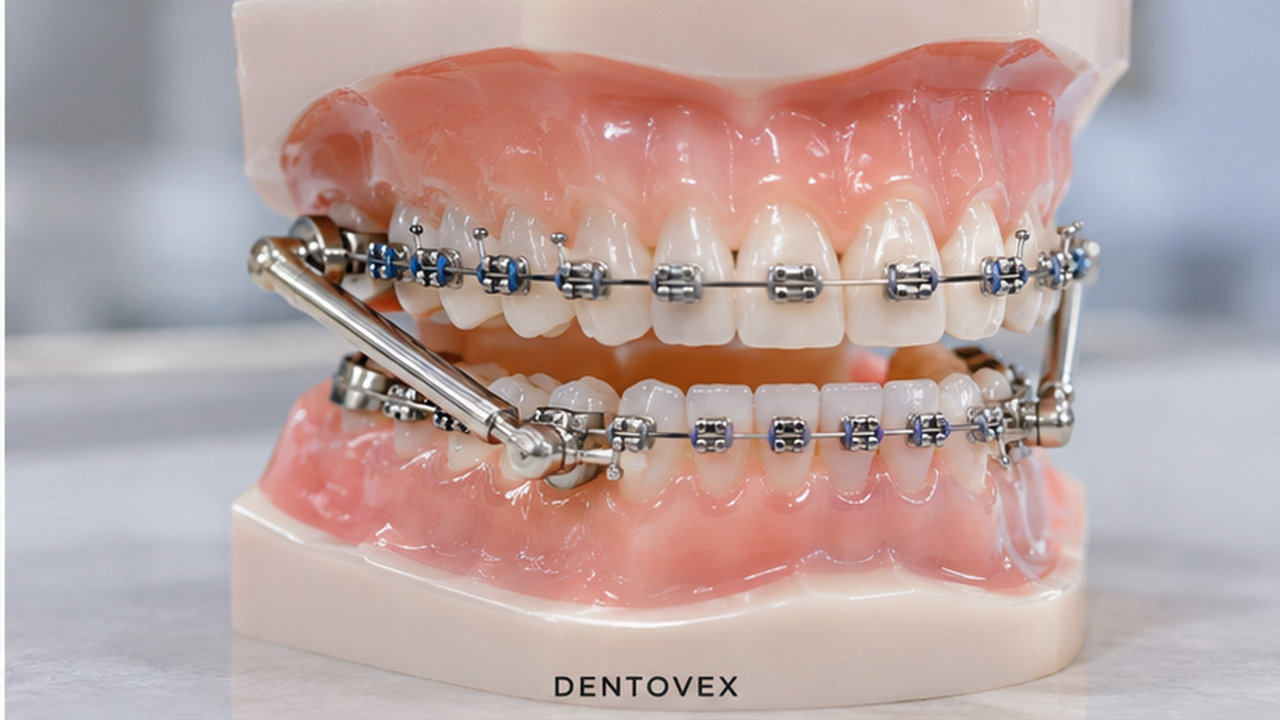
Quick answer: A Herbst appliance is a fixed orthodontic device that holds the lower jaw in a more forward position. Orthodontists most often use it for selected growing patients with a Class II bite problem particularly when the upper front teeth project too far ahead of the lower teeth. It can be used before or during braces, but it is not the right treatment for every overbite. Getting comfortable usually takes an adjustment period, and your orthodontist must determine the timeline and follow-up plan.
Parents sometimes hear that a Herbst device “grows the jaw.” That shorthand can be misleading. Research suggests that correction involves both tooth movement and skeletal changes, and the amount and durability of each change vary. This guide explains what the appliance actually does, daily care, the common annoyances and the limits of the research.
What does a Herbst appliance look like?
Most traditional Herbst systems use attachments on back teeth connected by metal arms or telescopic mechanisms on the right and left sides. The arms allow the mouth to open and close while helping maintain a forward position of the lower jaw. The exact design varies, and some are used with conventional braces. Cleveland Clinic’s Herbst appliance overview describes the usual components and reasons for using it.
This is not the same device as bite turbos, which create bite clearance for different orthodontic purposes. See our separate bite turbos guide. Nor is a Herbst appliance identical to removable rubber bands, even though some patients may later use orthodontic elastics as part of their treatment.
Overjet, overbite, and Class II: what is being treated?
These words often get mixed together:
| Term | What it describes | Why it matters |
|---|---|---|
| Overjet | Horizontal distance between upper and lower front teeth | Increased overjet is commonly part of the bite pattern considered for functional appliances |
| Overbite | Vertical overlap of upper and lower front teeth | A deep vertical bite is a different measurement and does not automatically require a Herbst |
| Class II malocclusion | A relationship in which the upper and lower dental arches/jaws do not meet in the usual front-to-back way | The orthodontist identifies the underlying dental and skeletal factors |
An appliance decision also depends on growth stage, dental health, jaw relationships, comfort and the overall treatment plan. Two children with similar-looking smiles may require different approaches. For the broader reasons to obtain a timely evaluation, see when a child should see an orthodontist.
What does the clinical evidence say?
A 2026 systematic review of seven randomized trials involving 548 participants compared Herbst and Twin Block treatment in growing patients with Class II malocclusion. Both methods improved the bite, with some modest advantages for Herbst in specific measures; most measured skeletal and soft-tissue outcomes were not significantly different. A 2024 randomized clinical trial involving 80 adolescents found meaningful overjet correction with both devices and highlighted that many treatment changes were dental rather than skeletal. A separate systematic review also found that some dentoskeletal effects differ little between Herbst and other Class II approaches.
What this means for families: there is evidence supporting Herbst as one tool for managing certain Class II bites, but it is not evidence that every patient will experience dramatic new jaw growth or a permanently transformed face. Study populations, appliances, follow-up periods and comparison treatments differ. An orthodontist should explain the expected benefits and uncertainties for the individual patient.
Herbst vs Twin Block: which is better?
A Twin Block is usually removable; a Herbst is generally fixed in place. That changes the daily experience as much as it changes treatment planning.
| Question | Fixed Herbst | Removable Twin Block |
|---|---|---|
| Must the patient remember to wear it? | Generally no; it stays attached | Yes, according to the prescribed wear schedule |
| Can it be taken out to eat? | Usually no | Often removed as instructed by the clinician |
| Is cleaning straightforward? | Extra brushing/flossing around fixed parts | Appliance cleaning plus normal oral care |
| What if a component breaks? | May require an orthodontic repair appointment | Loss, damage or under-wearing can interrupt treatment |
| Which produces better long-term results? | No universal winner for every child | No universal winner for every child |
The right choice depends on the orthodontist’s diagnosis and practical family factors. Do not choose based only on before-and-after pictures or social-media claims.
The first week: what might feel different?
Right after placement, the mouth may feel full. Chewing and speech may seem awkward. Teeth, jaw muscles or the inside of the cheeks can feel tender as the patient adapts. The Cleveland Clinic notes that adjustment often takes around one or two weeks, although individual experiences vary. Most initial soreness should be temporary rather than severe or steadily worsening.
Practical adjustment checklist
- Start with softer foods that are easy to cut into small bites.
- Chew slowly and avoid testing the limits of the appliance by opening your mouth dramatically.
- Brush carefully around the metal attachments after meals.
- Use orthodontic wax for an irritating spot only if the orthodontic team recommends it.
- Keep a record of persistent pain, new swelling or a component that seems out of place.
- Follow the clinic’s instructions for any prescribed pain relief rather than guessing about medicines or doses.
What can you eat with a Herbst appliance?
Comfortable first-week meals might include scrambled eggs, oatmeal, yogurt, tender pasta, cooked vegetables, soups at a safe temperature and soft fish. Avoid foods likely to pull on or fracture appliance parts: hard candy, nuts, chewing gum, tough crusts and particularly sticky sweets. The Cleveland Clinic care instructions and UMass Memorial Health guide both emphasize avoiding hard and sticky foods. Foods do not have to be pureed forever; most patients gradually find a comfortable routine.
If a patient cannot chew adequately, has increasing pain or is losing weight because eating has become difficult, contact the treating team rather than accepting it as an unavoidable phase.
Cleaning around the arms and attachments
Fixed arms create small areas where food and plaque can collect. Brush carefully at the gumline and around bands, tubes and visible appliance connections. Floss around the teeth with tools the orthodontist recommends, avoiding force or pulling on the device. A water flosser may help remove some debris but does not automatically replace all other plaque-control methods. If gums bleed persistently, the appliance smells unusual despite cleaning, or an area is difficult to reach, ask the orthodontic team for a hands-on demonstration.
Most patients will need braces as well as the Herbst device at some stage. Keeping both appliances clean protects gum health while teeth are being moved.
What if a Herbst arm or screw comes loose?
Do not assume one clinic’s repair instructions apply to every Herbst design. Different mechanisms may have different safe handling procedures. Some clinics teach patients how to reconnect a specific detachable part, while other designs should not be manipulated at home. If something disconnects, stop pulling or twisting it, contact the orthodontist, and follow your own practice’s instructions. Save a detached component if it can be handled safely. Avoid chewing on the side that has a loose or sharp part until advised.
Contact your orthodontist promptly for a loose band, unexplained severe pain, a broken connection, sores that prevent eating, or swelling. If there is trouble breathing or swallowing, major trauma or uncontrolled bleeding, seek emergency care. UMass Memorial Health advises calling the orthodontic team when parts break or cannot be reconnected as instructed.
How long do patients usually wear it?
The exact duration is not a universal number. Cleveland Clinic notes that many children wear a Herbst appliance for around a year, but severity, growth, response, and whether braces are used before or afterward all affect the plan. Your orthodontist should explain the expected functional phase, appointments, signs of progress and criteria for removal. A short initial estimate is not a promise that every bite will be corrected within that time.
Frequently asked questions
Does the Herbst appliance hurt?
Pressure and temporary soreness are common early on, but severe or worsening pain is not something to ignore. Contact your orthodontist if discomfort interferes with eating, sleeping, or normal activity.
Can you play sports with a Herbst appliance?
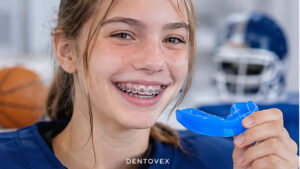
Often yes, but contact-sport protection and mouthguard fit require individual advice because the fixed appliance changes the shape of the dental arch. Discuss the sport and equipment with the orthodontist before play.
Can I open my mouth normally?
The design generally allows routine opening and closing, but the sensation and range can feel different at first. If the mechanism jams, bends or limits movement significantly, contact your clinic.
Is Herbst only for young teenagers?
It is most often discussed for growing patients, but exact candidacy depends on diagnosis and stage of development. Adults need a different individualized assessment.
Will Herbst avoid jaw surgery?
No appliance can promise that. Some growing patients may reduce certain bite discrepancies with orthodontic treatment, while others have skeletal problems requiring a different approach.
Do patients still need braces afterward?
Many do, or wear braces at the same time, to align individual teeth and refine how the bite fits together.
Are Herbst and headgear the same thing?
No. They differ in design, mechanics and how treatment is delivered. Only an orthodontic assessment can determine which option is appropriate.
Questions to bring to the next appointment
Ask: “Is the main issue overjet, overbite, or skeletal Class II?” “Which changes are expected from teeth versus jaws?” “What are the alternatives?” “How will you monitor progress?” “What should we do if a connector detaches?” and “What changes would make you revise the treatment plan?” Useful answers are specific to the patient’s bite, not to a generic success story.
Medical information notice: General educational information only. This draft has not been independently reviewed by a clinician on behalf of Dentovex. It does not replace orthodontic diagnosis or instructions for your particular Herbst appliance.
No responses yet