The Unsung Micro-Engineers of Orthodontics When you embark on a journey to correct your smile using fixed orthodontic appliances, you expect to see brackets bonded to the front of your teeth and a metallic archwire threading them together. However, many patients sit up from the dental chair during their initial bonding appointment, bite down, and experience a sudden shock. Their back teeth no longer meet. Instead, their front or back teeth hit small, intentional mounds of composite resin or metal rams.
Welcome to the world of bite turbos also widely referred to in clinical settings as bite blocks, bite ramps, or occlusal openings.
At Dentovex, we recognize that encountering bite turbos for the first time can trigger immediate anxiety. It feels fundamentally unnatural to have your jaws propped open, and your mind immediately jumps to questions: “How am I supposed to chew my food? Will I speak with a permanent lisp? Did my orthodontist make a mistake?”
This comprehensive, deep-dive architectural manual is engineered to demystify bite turbos completely. We will dissect the biomechanical physics behind why these tiny devices are vital to your treatment, analyze the different styles utilized by clinicians, outline structural adaptations for eating and speaking, and provide a realistic timeline for your oral transition.
1. What Are Bite Turbos and Why Do You Need Them?
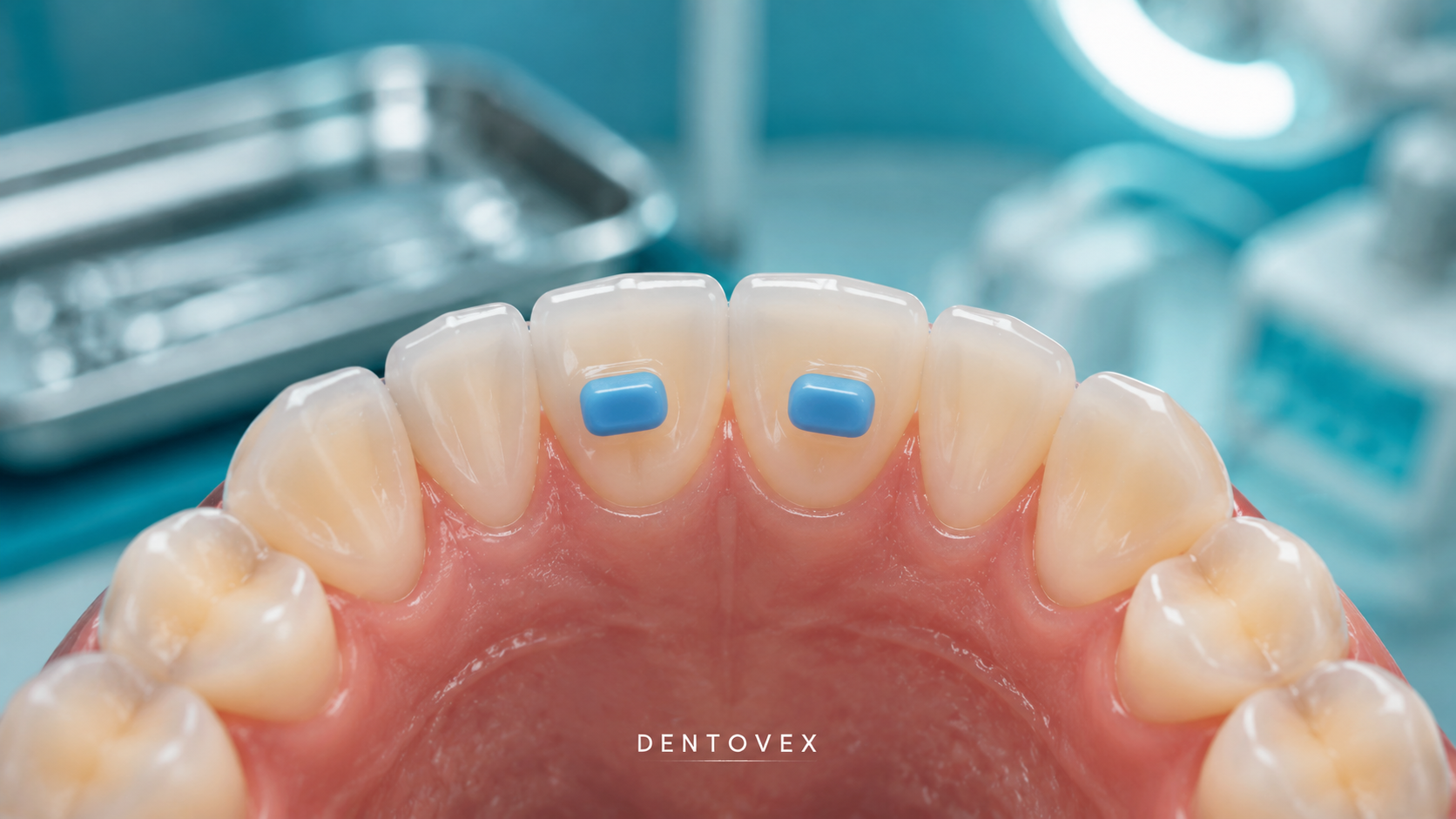
Bite turbos are small, temporary structural attachments bonded directly to either the palatal (back) surfaces of the upper front teeth or the occlusal (biting) surfaces of the lower back molars. They do not contain moving parts, springs, or active wires. Instead, they function as passive mechanical barriers that intentionally alter how your upper and lower arches interact when your jaw closes.
[Upper Front Tooth] ➔ [Bite Turbo Bonded Behind Enamel]
                              ↕ (Intended Mechanical Air Gap)
[Lower Front Tooth] ➔ [Resting Position Prevents Over-Closure]
An orthodontist installs bite turbos to resolve two primary, interconnected clinical challenges:
A. Mechanical Bracket Protection
If you suffer from a severe deep bite a condition where your upper front teeth overlap your lower front teeth excessively the moment braces are bonded to your lower teeth, your upper teeth will crash directly down onto those lower brackets whenever you chew or swallow.
The human jaw muscle (the masseter) can exert immense force. If your upper teeth repeatedly slam into your lower brackets, you will break those brackets off your enamel continuously. Every broken bracket requires an emergency clinic visit, stalls your biological tooth movement, and extends your overall treatment timeline. Bite turbos act as a physical stop-sign, propping your jaw open just enough so that your upper teeth can never make physical contact with your lower hardware.
B. Accelerated Deep Bite Correction (Biomechanical Intrusion/Extrusion)
Beyond protecting your brackets, bite turbos are active accelerators of bone remodeling. When your back teeth are held apart by turbos placed on your front teeth, your back molars are left hanging in a state of suspension with no opposing forces pushing down on them.
Over a period of weeks, biology takes over. Your back molars will naturally undergo a process called extrusion they will slowly grow vertically until they meet again. Concurrently, the constant biting pressure placed on the front turbos causes the front teeth to slightly intrude (move deeper into the jawbone). This dual biomechanical action flattens your overall bite plane, correcting your deep bite in a fraction of the time it would take using wires alone.
2. The Main Classifications of Bite Blocks
Not all bite turbos are created equal. Your specialist will select a specific archetype based entirely on your unique malocclusion, facial profile, and aesthetic preferences.
A. Anterior Resin Bite Turbos
These are the most common variants utilized in modern orthodontics. They are custom-sculpted by the orthodontist behind the upper front central incisors using a specialized, high-strength dental composite resin.
- The Visual Design: They are frequently shaped like tiny, triangular ramps or small ledges.
- The Color Factor: Clinicians often use bright blue, pink, or neon composite material instead of tooth-colored resin. This isn’t accidental; it makes the turbos highly visible to both you and the practitioner, ensuring they can be tracked easily and polished off your enamel at the end of their lifecycle without damaging your natural tooth structure.
B. Metal Anterior Turbos
For patients who display extreme bruxism (severe teeth grinding) or possess incredibly dense enamel configurations, resin turbos can wear down too quickly. In these scenarios, pre-fabricated metal bite turbos made of medical-grade stainless steel are used. They are bonded using orthodontic adhesive and provide an indestructible mechanical stop, though they feel slightly more noticeable to the tip of the tongue.
C. Posterior Bite Blocks
If your clinical issue is an open bite teeth configuration or an inverse crossbite, your orthodontist may choose to place flat blocks of composite material directly on the biting surfaces of your lower or upper back molars. This prevents the front teeth from closing completely while allowing the clinician to manage the vertical growth patterns of your posterior segments.
3. The Adaptation Blueprint: Speech, Lisps, and Phonetics
The first 48 to 72 hours with bite turbos can feel challenging. Because your tongue relies on making exact, precise contact with the back of your front teeth to produce specific sounds, placing a new resin ramp in that exact zone will immediately disrupt your speech patterns.
Why Do You Lisp?
When pronouncing words containing “S,” “T,” “D,” or “C” sounds, your tongue tip must compress against the palate directly behind your incisors. With anterior turbos in place, your tongue strikes the ramp prematurely, causing air to escape laterally. This results in a noticeable lisp.
The Speech Rehabilitation Protocol
The human brain possesses incredible neuroplasticity. Your tongue will naturally learn to map the new layout of your oral cavity, but you can accelerate this adaptation process using specific exercises:
1.Over-Enunciation Practice:Day 1 – 3.
Find a private, quiet space and read aloud from a book or article for 15 to 20 minutes twice a day. Intentionally slow down your speech and violently over-enunciate every single syllable, forcing your tongue to work harder around the turbos.
2.The High-Frequency Sound Sprints:Day 4 – 7.
Practice repeating tongue-twisters or word matrices that are heavy on “S” and “T” sounds (e.g., “Sixty-six structural specialists”). This specific repetition trains the muscular memory of the tongue tip to find alternative resting compression points.
3.Natural Velocity Transition:Week 2.
Gradually increase your talking speed back to your normal conversational velocity. By this phase, the subconscious mind will have re-calibrated your phonetic execution, and your lisp will diminish to a level that is barely perceptible to those around you.
4. The Dietary Survival Strategy: Eating Safely Without Molars Meeting
The most frustrating aspect of bite turbos is realizing that your back teeth do not touch, making traditional chewing physically impossible during the initial stage of treatment. Attempting to force an ordinary diet can lead to jaw fatigue and profound frustration.
To maintain optimal nutrition while protecting your appliances, you must adapt your dietary architecture temporarily.
The Nutritional Phase-Down Matrix
During the first two to three weeks, categorize your meals strictly by texture, relying entirely on foods that require minimal mechanical grinding:
| Food Category | Recommended Options | Items to Absolutely Avoid |
|---|---|---|
| Proteins & Staples | Flaky baked fish, scrambled eggs, slow-cooked pulled chicken, tofu, well-mashed lentils. | Thick steaks, tough chicken breasts, dense beef jerky. |
| Carbohydrates | Creamy mashed potatoes, over-boiled pasta shapes, oatmeal, soft polenta, quinoa bowls. | Al dente pasta, crusty baguettes, hard bagels, pizza crusts. |
| Fruits & Vegetables | Steamed broccoli florets, roasted zucchini, soft avocados, fruit smoothies, applesauce. | Whole raw apples, raw carrots, celery sticks, corn on the cob. |
| Dairy & Snacks | Greek yogurt, cottage cheese, smooth puddings, bone broths, soft cheeses. | Chewy caramels, nuts, seeds, thick potato chips. |
Technical Chewing Mechanics
Because your molars don’t meet, you must rely on your tongue and the flat surfaces of the bite turbos themselves to break down soft foods. Cut your food into microscopic, bite-sized pieces before placing it in your mouth. Let your saliva and the natural warmth of your mouth soften the food further before swallowing.
As the weeks pass, your back molars will extrude vertically, closing the air gap. Within a couple of months, you will regain full chewing surface contact, and eating will return to a completely seamless routine.
5. Comprehensive Hygiene Protocols for Bite Turbos
Because anterior bite turbos are tucked safely out of sight behind your front teeth, they represent a significant danger zone for the accumulation of microscopic food debris and bacterial plaque. If this zone is neglected, it can quickly lead to localized enamel decalcification (permanent white spots) or severe palatal gingivitis.
- The Post-Meal Mirror Flush: Every single time you consume food, immediately rinse your mouth with high-velocity lukewarm water to dislodge large food remnants trapped around the base of the resin ramps.
- The Angled Mechanical Sweep: When brushing your teeth, do not ignore the lingual (internal) surfaces. Angle the bristles of your soft toothbrush at a 45-degree angle directly toward the gumline behind your upper front teeth. Use a gentle, circular sweeping motion to clean the crevices where the turbo meets your enamel.
- Integrating Advanced Cleaning Modalities: Utilizing a high-pressure water flosser directed at the lingual surfaces is exceptionally effective at blasting away plaque biofilm that hand-brushes miss. Additionally, consider introducing an antimicrobial mouthwash containing cetylpyridinium chloride (CPC) to keep bacterial populations under control without staining the resin.
6. What Constitutes a Bite Turbo Emergency?
Like any orthodontic appliance attached via chemical adhesives, bite turbos can occasionally experience structural failure. Knowing how to react preserves your treatment continuity.
A. The Single Turbo Detachment
If your orthodontist placed two anterior turbos and one of them fractures or falls off while you are chewing, do not panic. As long as the remaining turbo still physically prevents your upper teeth from biting down onto your lower brackets, your system is still functional. Schedule a routine appointment over the next week to have the missing turbo re-bonded.
B. Complete Bilateral Failure
If both bite turbos break off or wear down to the point where your upper teeth are once again smashing directly into your lower braces, this constitutes a legitimate clinical emergency. Stop chewing immediately to avoid shearing off your lower brackets. Contact your specialist’s office right away to secure an urgent emergency chair-time slot for re-stabilization.
C. Persistent Ulceration
In the first week, your tongue may develop sore spots or aphthous ulcers from constantly rubbing against the edges of the new turbos. This is a standard tactile response. Apply a small pea-sized amount of clean orthodontic wax over the sharp edges of the turbos before bed, and rinse with warm salt water to accelerate soft tissue healing.
7. The End Game: How and When Are Turbos Removed?
Bite turbos are never a permanent fixture of your dental anatomy. They are a means to an end.
Typically, your specialist will leave them in place for anywhere from 3 to 9 months. The removal trigger is entirely dependent on your biological progress: once your lower wire has successfully aligned your lower teeth out of harm’s way, or once your back molars have fully extruded to create a stable, flat bite plane, the turbos have completed their mission.
The Removal Experience
The physical process of removing bite turbos is completely non-invasive and painless:
- De-Bonding: The orthodontist uses a specialized, smooth dental plier to apply a precise geometric pressure to the base of the turbo, safely shearing the bulk of the resin away from the enamel.
- Polishing: Using a high-precision, slow-speed tungsten carbide finishing bur, the clinician gently polishes away the microscopic adhesive residue left on your tooth. Because carbide burs are designed to target resin while leaving dense human enamel completely untouched, your natural tooth surface is left perfectly smooth, pristine, and undamaged.
Trust the Mechanical Engineering While bite turbos are undeniably one of the most physically noticeable and character-testing components of fixed orthodontic therapy, they represent an absolute triumph of clinical engineering. They are the defensive shields that protect your investment from mechanical failure while quietly rewriting the biological architecture of your deep bite behind the scenes.
If you are struggling with a lisp, jaw fatigue, or a soft-food diet during your first week with turbos, take a deep breath and stay patient. Your tongue will adapt, your molars will reach out to meet one another, and the temporary inconvenience will give way to a perfectly balanced, stable, and radiant lifetime bite. Trust the blueprint, partner openly with your clinician, and protect your path to a healthier future.
Disclaimer: The placement, sizing, and duration of bite turbo wear must be meticulously calibrated by a certified orthodontic specialist following 3D radiographic assessment. Never attempt to manually alter, file down, or remove orthodontic bite blocks at home, as this can result in permanent structural fracturing of your natural dental enamel.
No responses yet