The Space Dilemma in Orthodontics When you look at a set of crowded teeth, the underlying problem is almost always mathematical: the total width of your teeth is greater than the available perimeter of your jawbone. To align them perfectly, we have to find space. Historically, the traditional solution to severe crowding was straightforward but invasive we extracted healthy premolar teeth to create a gap.
However, modern orthodontics avoids extractions whenever biologically possible. Instead of removing entire teeth, we utilize a precise, microscopic space-creation technique known as interproximal reduction (IPR).
If you are undergoing clear aligner therapy or wearing fixed braces, your treatment plan will likely include a stage marked “IPR.” At Dentovex, we notice that the mere mention of “polishing” or “slenderizing” teeth can cause immediate health anxiety in patients. In this technical guide, we strip away the clinical intimidation to explain exactly how IPR works, why it is entirely safe for your enamel, and what to expect during the procedure.
1. What is Interproximal Reduction (IPR)?
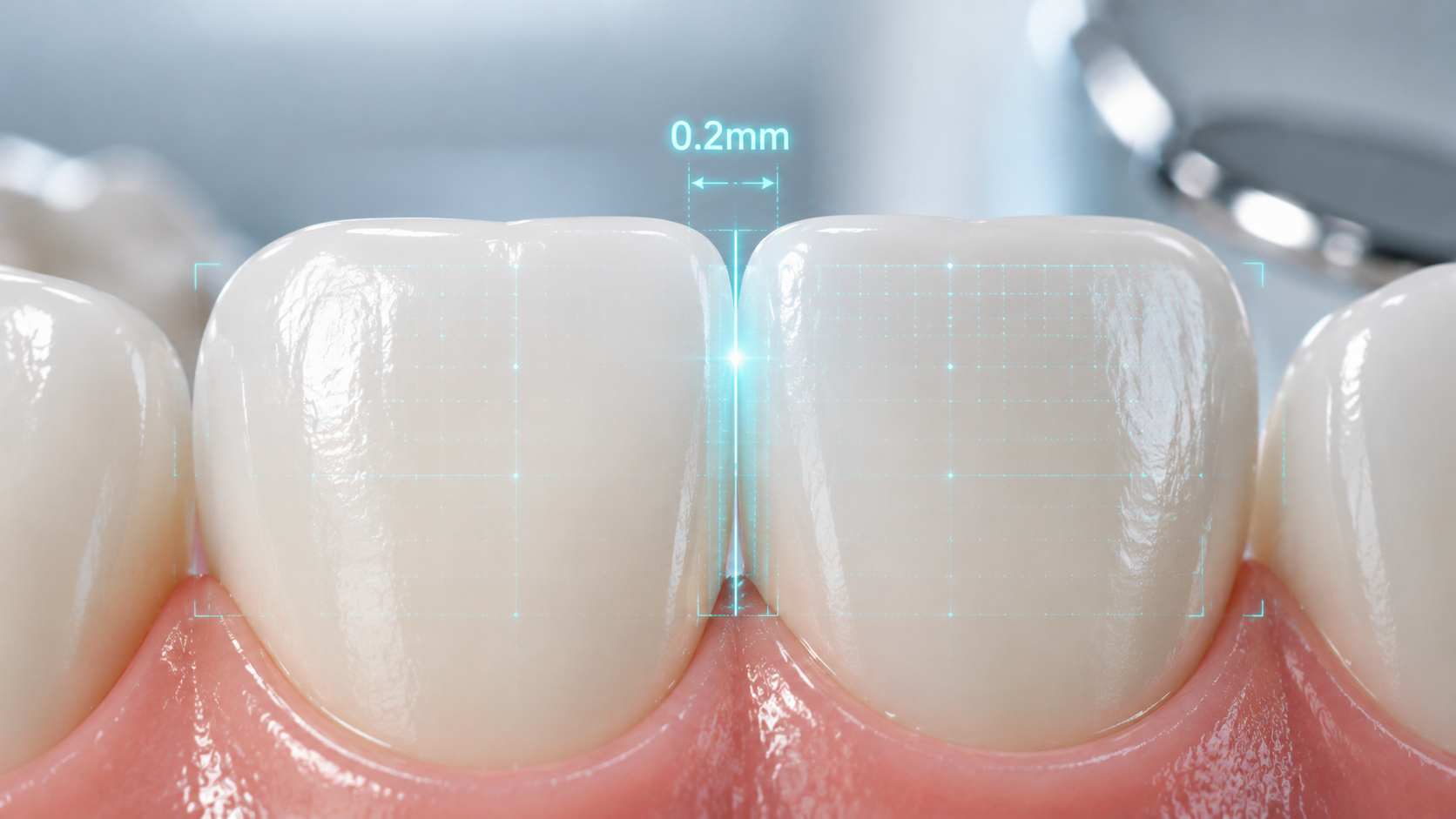
Interproximal reduction often referred to as IPR, tooth slenderizing, or enamel stripping is the clinical process of removing a minute, microscopic amount of outer enamel from the contact points where adjacent teeth touch.
[Tooth A] ➔ | IPR Zone: 0.2mm to 0.5mm | ➔ [Tooth B]
The goal is to create just enough clearance to allow crowded, overlapped, or rotated teeth to pass by one another as they slide into alignment.
How much enamel are we talking about? The numbers are incredibly conservative. In a typical orthodontic protocol, we only remove between 0.2 millimeters and 0.5 millimeters of enamel per contact surface. To put that into perspective, an average single sheet of paper is about 0.1 millimeters thick. We are essentially polishing away a fraction of a millimeter to solve a complex structural crowding issue.
2. The Biological Safety of IPR: Will It Damage Your Teeth?
The most frequent concern patients share is: “If you remove my enamel, won’t my teeth decay or become incredibly sensitive?”
Clinically, the answer is an absolute no, provided the procedure is performed by a qualified orthodontic specialist. Here is the biological reality behind why your teeth remain completely protected:
- The Enamel Buffer Zone: The outer layer of human dental enamel is typically 1.5mm to 2.5mm thick depending on the tooth type. Removing 0.2mm to 0.3mm leaves the vast majority of your protective enamel shield completely intact. It does not expose the sensitive inner layer of dentin.
- Decay Resistance: Decades of clinical studies show that surfaces treated with proper IPR do not have a higher risk of developing dental caries (cavities). In fact, because the teeth are eventually aligned perfectly, the area becomes far easier to floss, actually reducing your long-term plaque buildup and gum disease risk.
- Fluoride Uptake: Following the polishing process, the freshly smoothed enamel surfaces are highly receptive to natural remineralization from your saliva and topical fluoride applications.
3. How Is the Procedure Performed? (Step-by-Step)
Understanding the actual mechanics of the appointment can significantly lower dental anxiety. The process is completely mechanical and does not require local anesthesia (numbing injections) because there are no nerve endings inside the enamel matrix.
1.Access and Measurement: Step 1.
Your orthodontist will first check the contact points of the targeted teeth using ultra-thin, specialized thickness gauges to confirm the baseline measurements.
2.Gentle Slenderizing:Step 2.
Using either a flexible, diamond-coated manual strip (which looks like a tiny, metallic piece of floss) or a slow-speed mechanical oscillating disc, the clinician gently polishes the side of the tooth. You will feel a strong vibration and hear a rattling sound, but you will not experience sharp pain.
3.Precision Calibration:Step 3.
The orthodontist continuously measures the newly created gap with a precision feeler gauge to ensure they create exactly the amount of space prescribed by your digital setup never a fraction more.
4.Smoothing and Topical Defense:Step 4.
The rough edges are polished to a glass-like finish to prevent plaque accumulation. Finally, a topical fluoride varnish is often applied to speed up natural enamel remineralization.
4. IPR vs. Extractions: Weighing Your Options
Why choose interproximal reduction over traditional tooth extractions? When your crowding is mild-to-moderate, IPR offers distinct biological advantages:
| Parameter | Interproximal Reduction (IPR) | Premolar Extraction |
|---|---|---|
| Tissue Invasiveness | Minimally invasive; preserves whole teeth | Surgical removal of a complete, healthy root |
| Impact on Facial Profile | Maintains full jaw width and lip support | Can occasionally flatten the profile if space isn’t managed perfectly |
| Treatment Timeline | Accelerates alignment by creating immediate space | Adds months to close wide, 7mm extraction gaps |
| Recovery | Zero downtime; immediate return to normal eating | 3-7 days of surgical tissue healing |
5. The Esthetic Side Effect: Banishing “Black Triangles”
Beyond creating room for alignment, IPR is an outstanding aesthetic tool for correcting gingival embrasures, commonly known as “black triangles.”
When crowded teeth are straightened, the gum tissue between them sometimes fails to fill the gap near the gumline, leaving a small, dark, triangular shadow. By gently using IPR to flatten the rounded sides of those teeth, we can slide them closer together. This completely closes the black triangle, creating a broad, continuous, youthful-looking smile line.
Conclusion: Trust the Digital Blueprint Interproximal reduction is a cornerstone of modern, conservative orthodontics. It represents the perfect marriage between meticulous digital pre-planning and delicate clinical execution. If your clear aligner sequence or braces plan calls for IPR, remember that it is a painless, highly controlled procedure designed to save you from invasive extractions while protecting your long-term enamel health.
If you have specific concerns about sensitivity or the exact thickness of your dental enamel, always ask your orthodontic specialist to walk you through your 3D digital model during your adjustment consult.
Disclaimer: This article is for educational purposes only. Interproximal reduction must be diagnosed, planned, and calibrated via 3D imaging software and executed exclusively by a licensed orthodontic professional.
No responses yet