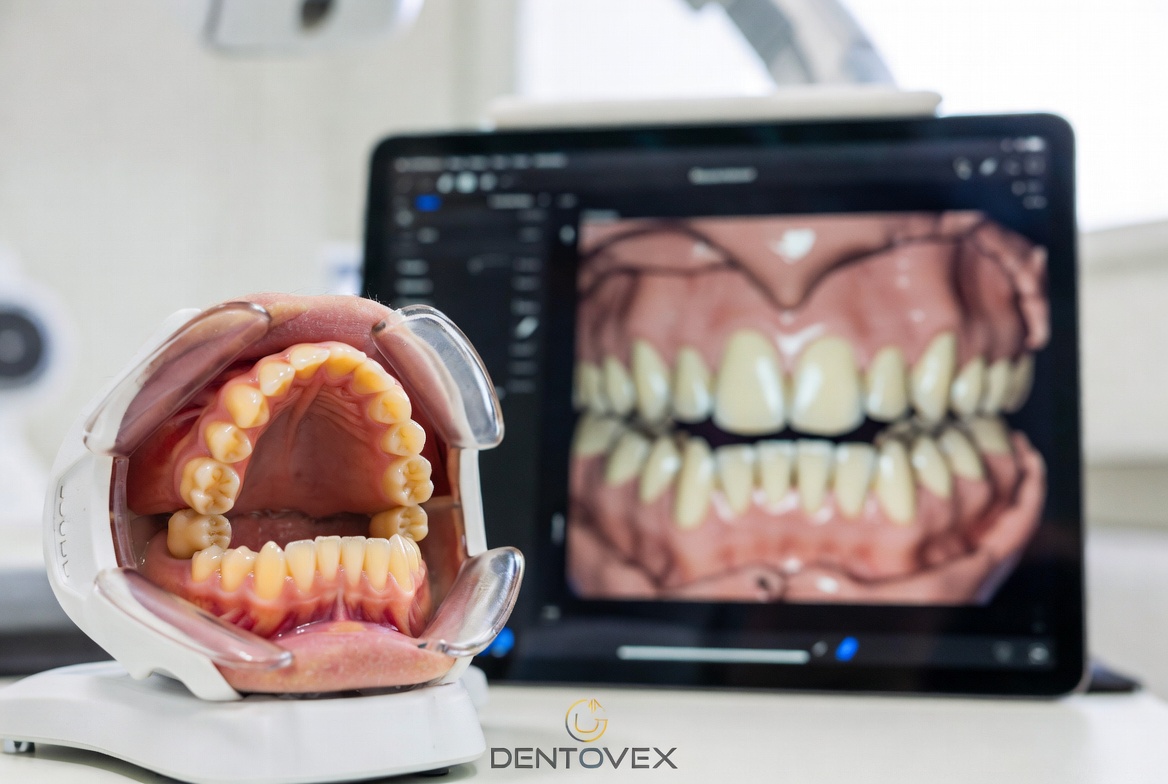
When Your Teeth Don’t Meet When you look in the mirror and bite down, your teeth should fit together like a puzzle, with the upper teeth slightly overlapping the lower ones. But what happens when you bite down, and your front teeth or even your side teeth simply don’t touch? There’s a visible gap left between your upper and lower arches. In orthodontics, we call this an “open bite.”
While an open bite is often viewed as an aesthetic concern, it is fundamentally a functional issue. It affects how you chew, how you speak, and how your jaw joint (TMJ) handles the pressure of daily life. At Dentovex, we treat open bite cases with a focus on stability because fixing an open bite isn’t just about closing the gap; it’s about ensuring it stays closed for good.
1. Defining “Open Bite”: Why Does It Happen?
An open bite isn’t just one condition; it’s a spectrum. We generally categorize them by where the gap occurs:
- Anterior Open Bite: The most common form, where the front teeth don’t touch when you bite down.
- Posterior Open Bite: Where the back teeth don’t meet.
- Skeletal vs. Dental: This is the most crucial distinction. A dental open bite is caused by habits or tooth positioning. A skeletal open bite is caused by the actual growth pattern of your jawbones.
The “Why” Behind the Gap:
- Tongue Thrusting: If your tongue pushes against your front teeth every time you swallow (and we swallow thousands of times a day), that constant pressure can slowly push the teeth apart.
- Thumb Sucking/Pacifier Use: Lingering habits in childhood are the leading cause of dental open bites.
- Genetics: Some people are simply born with a vertical growth pattern of the jaw that naturally leads to an open bite.
- TMJ Issues: Sometimes, chronic inflammation or degeneration of the jaw joint can cause the jaw to rest in a position that leaves the teeth apart.
2. Why Should You Fix Your Open Bite?
“It’s just a gap does it really matter?” Yes. Leaving an open bite untreated can lead to several long-term issues:
- Accelerated Wear and Tear: When your front teeth don’t touch, your back teeth have to do all the heavy lifting. This causes premature grinding and enamel loss on your molars.
- Speech Impediments: Many people with an anterior open bite struggle with “S” or “T” sounds, often resulting in a slight lisp.
- Jaw Pain (TMJ): Because your bite is unstable, your jaw muscles are constantly working to find a comfortable position, leading to headaches, neck pain, and TMJ dysfunction.
3. The 2026 Orthodontic Solutions
In the past, the only “real” fix for a severe skeletal open bite was jaw surgery (orthognathic surgery). While surgery is still the gold standard for extreme cases, 2026 technology gives us powerful alternatives.
A. Clear Aligner Therapy (The Non-Invasive Route)
For mild-to-moderate dental open bites, clear aligners are a game-changer. By using precise force-application points, we can move the teeth vertically to “close” the bite. The secret in 2026 is the use of vertical elastics (tiny rubber bands) that work in harmony with your aligners to guide the teeth into contact.
B. TADs (Temporary Anchorage Devices)
This is where clinical orthodontics gets impressive. TADs are tiny, sterile, titanium mini-screws that we temporarily place in the jawbone. They act as “fixed anchors,” allowing us to pull the back molars upward into the jawbone, which effectively allows the front of the bite to rotate closed. It sounds intense, but the procedure is quick, minimally invasive, and requires almost no recovery time.
C. Orthognathic Surgery (For Skeletal Cases)
If the open bite is purely skeletal meaning your jawbone grew in a way that makes closure impossible with teeth movement alone surgery remains the most reliable route. In 2026, surgical techniques are highly advanced, with faster recovery times and much more predictable aesthetic results.
4. The “Stability” Challenge: Why Open Bites Relapse
Open bites are notorious for their tendency to “spring back.” This is why, at Dentovex, we emphasize Retainers for Life. If your open bite was caused by a tongue thrust, the teeth will always want to move back unless we address the underlying habit. This is why we often pair our orthodontic treatment with myofunctional therapy essentially “physical therapy” for your tongue and mouth muscles to retrain them to swallow and rest correctly.
5. What to Expect During Treatment
- The Comprehensive Exam: We start with 3D CBCT scans to see if your open bite is dental or skeletal.
- The Myofunctional Assessment: We evaluate your tongue position and swallowing pattern.
- The Plan: We define whether you need aligners, TADs, or a surgical referral.
- The Monitoring: Using the remote monitoring app (as discussed in our M36 guide), we track your progress every week to ensure the bite is closing exactly as planned.
Conclusion: Closing the Gap An open bite is not a life sentence. Whether it’s a small gap that bothers you in photos or a functional issue that causes jaw pain, 2026 technology has provided us with more tools than ever to fix it without resorting to invasive measures. You deserve a bite that is not only beautiful but also healthy and stable.
If you’ve been living with an open bite, the best first step is a clinical evaluation. We’ve helped hundreds of patients close the gap and restore the harmony of their smile. You could be next.
Disclaimer: Open bite cases are complex and require a professional evaluation by an orthodontist. Do not attempt “DIY” aligner treatments for an open bite; it can lead to permanent damage to your jaw joint and tooth roots.
No responses yet