Resolving Lateral and Anterior Mismatches
In a healthy dental arch relationship, the upper teeth fit over the outside of the lower teeth like a lid on a box. When this natural relationship is reversed on one or more teeth, the condition is known as a crossbite.
A crossbite can occur at the front of the mouth (anterior crossbite) or along the sides (posterior crossbite). Left uncorrected, it creates severe mechanical stress across the entire masticatory system. Patients often suffer from asymmetric jaw growth, premature enamel fracture, localized gum recession, and temporomandibular joint (TMJ) painful clicking.
Correcting a crossbite requires targeted transverse or anteroposterior mechanical forces to widen the upper arch or pivot individual teeth over the lower bite barrier.
At Dentovex, we evaluate crossbites to differentiate between single-tooth dental shifts and structural skeletal narrowness. In this guide, we analyze the mechanics of crossbite correction, compare crossbite braces with expansion appliances, detail cross-elastic setups, and outline lifetime retention protocols.
1. Differentiating Crossbite Types: Anterior vs. Posterior
A precise clinical diagnosis determines whether treatment requires simple bracket adjustments or orthopedic arch expansion.
1. Anterior Crossbite
Occurs when one or more upper front teeth land behind the lower front teeth when closing the mouth. While it looks similar to an underbite, an anterior crossbite often involves only a few specific teeth rather than a full lower jaw mismatch.
2. Posterior Crossbite
Occurs when the upper back teeth fit inside the lower back teeth. This condition usually stems from a narrow upper jaw (maxilla). Posterior crossbites can be unilateral (occurring on one side) or bilateral (occurring on both sides). Unilateral crossbites frequently force the patient to slide their lower jaw to one side to chew, leading to facial asymmetry over time.
2. Dental vs. Skeletal Origin
| Parameter | Dental Crossbite | Skeletal Crossbite |
| Primary Cause | Misaligned tooth angles or crowded eruption path. | Narrow upper jaw bone or wide lower jaw bone structure. |
| Jaw Position | Symmetrical skeletal alignment; normal palate width. | Narrow, high-arched palate; asymmetry upon closing. |
| Primary Treatment | Fixed Braces, Clear Aligners, Cross-Elastics. | Palatal Expander (Rapid Maxillary Expander), Surgical Assistance (SARPE). |
3. Biomechanical Appliances: How Braces Correct a Crossbite
Orthodontists combine fixed brackets with transverse force vectors to expand arches and cross teeth back over the lower dental track.
1. Palatal Expanders
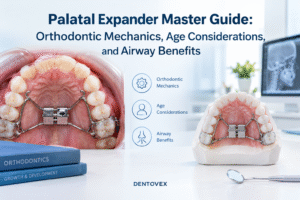
In growing children and young adolescents, an orthopedic palatal expander is anchored to the upper molars. By turning a central screw key daily, mild transverse pressure widens the un-fused midpalatal suture, expanding the upper jaw bone directly.
2. Cross-Intermaxillary Elastics
Specialized rubber bands are engaged across the jaws in a crisscross pattern. The band hooks from the inside (lingual) surface of an upper tooth to the outside (buccal) surface of a lower tooth. As explained in our guide on rubber bands for braces, this vector pulls the upper tooth outward while pulling the lower tooth inward simultaneously.
3. Expansion Archwires & Torque Adjustments
Orthodontists can shape wide titanium archwires and apply deliberate bracket torque to push upper teeth outward (buccal tipping) while pulling lower teeth inward, correcting mild dental crossbites without heavy appliances.
4. The Clinical Workflow for Crossbite Correction
Correcting a crossbite follows a structured multi-phase protocol:
1.1. Digital Scanning & Palatal Measurement:Transverse diagnostic mapping.
Intraoral 3D scans and CBCT imaging evaluate palatal width, root positions, and TMJ seating to determine whether the issue is structural or dental.
2.2. Palatal Expansion Phase:Skeletal preparation (if required).
If the upper jaw is skeletal narrow, a palatal expander is fitted first. Expansion creates necessary arch width over 2 to 4 weeks, followed by a 3-month stabilization period.
3.3. Leveling & Cross-Elastic Traction:Fixed appliance engagement.
Braces (metal or ceramic) are bonded to both arches. Cross-elastics are engaged to shift individual teeth across the biting line into proper overlap.
4.4. Occlusal Detailing & Settling:Restoring solid contact points.
Individual bracket positions are adjusted to ensure all back cusps interlock tightly, eliminating jaw shifting and relieving joint pressure.
5.5. Targeted Retention Protocol:Long-term transverse protection.
Custom orthodontic retainers (such as Hawley retainers with acrylic palatal coverage) hold the widened arch form stable against biological relapse.
5. Age Limits and Non-Surgical Treatment Boundaries
- Children and Adolescents: Highly responsive to non-surgical orthopedic expansion. Bone sutures are open, allowing rapid palatal expansion in just a few months.
- Adult Patients: Because adult facial sutures are fully calcified, true skeletal expansion requires Surgically Assisted Rapid Palatal Expansion (SARPE) or TAD-supported expanders (MSE). However, mild to moderate dental crossbites in adults are easily managed using adult braces combined with cross-elastics.
During cross-elastic wear, any cheek irritation caused by hooks can be instantly relieved by applying medical-grade orthodontic wax over prominent bracket extensions.
Conclusion: Restoring Symmetry and Chewing Efficiency
Resolving a crossbite protects your teeth from premature wear and establishes true jaw symmetry. By combining palatal expansion with targeted cross-elastic mechanics, modern orthodontics effectively eliminates crossbites, restores comfortable chewing function, and safeguards long-term TMJ health.
Disclaimer: Crossbite treatment mechanics depend heavily on skeletal age and palatal width. Always consult a licensed orthodontic specialist for a detailed diagnostic evaluation.
No responses yet