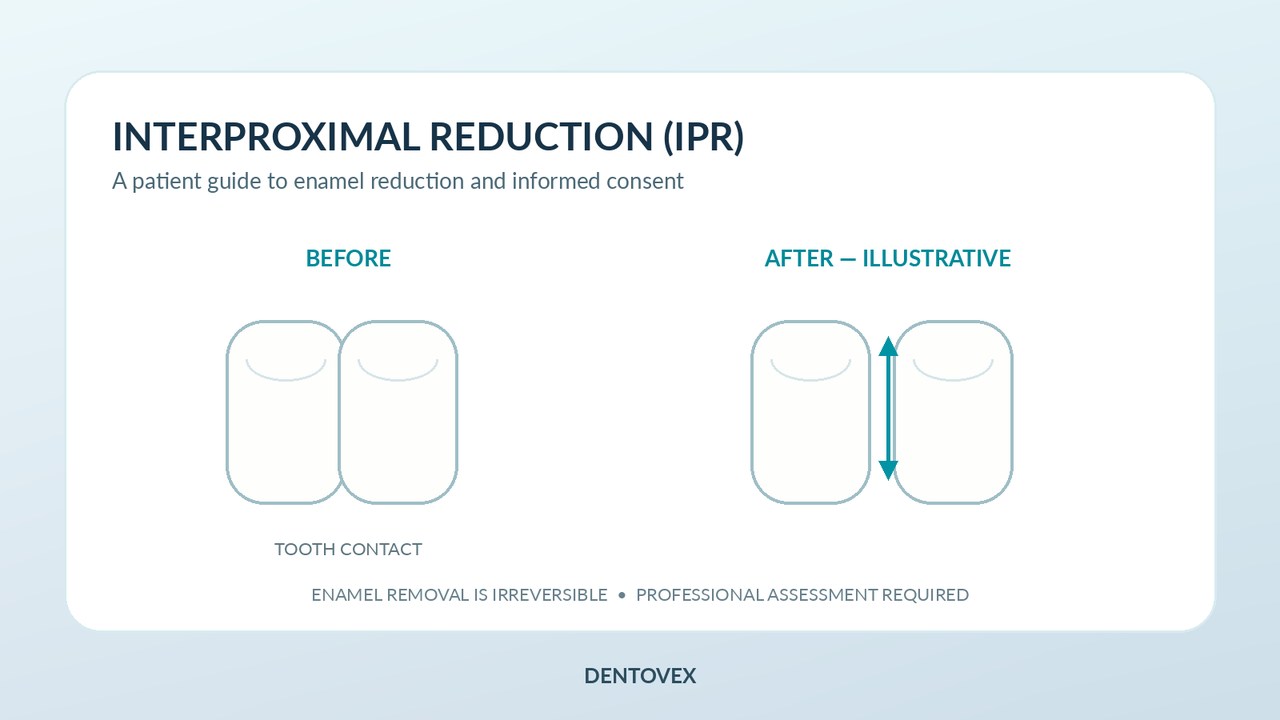
Interproximal reduction (IPR) is a dental procedure in which an orthodontist or appropriately trained dentist removes a carefully planned, small amount of enamel from selected surfaces between teeth. It may create room for alignment or change tooth contact shapes. Research has not consistently found higher cavity rates after appropriately performed IPR, but enamel removal is irreversible and the evidence has important limitations. Whether it is suitable depends on the patient’s teeth, gums, and orthodontic plan.
If your clear-aligner plan or braces treatment includes “IPR,” you may wonder whether your teeth are being shaved, whether it hurts, and whether removing enamel can increase cavities. Those are reasonable questions. IPR is a real clinical technique, but it should not be described as risk-free or as the best option for everyone.
This guide separates what the procedure does, what research supports, what remains uncertain, and what you should ask before consenting. It is written for patients—not as a do-it-yourself clinical protocol.
What Is Interproximal Reduction?
Interproximal reduction means reducing a controlled amount of enamel from the surfaces where neighboring teeth touch. You may also hear the terms enamel reduction, tooth slenderizing, interproximal enamel reduction (IER), or stripping. The goal is usually to gain a limited amount of space without removing an entire tooth, or to modify the shape of a contact between teeth.
The procedure is planned for selected contacts, not necessarily every tooth. A clinician may use specialized abrasive strips or discs and then smooth the treated enamel. How much is removed is an individualized clinical decision based on tooth shape, enamel anatomy, periodontal condition, and the amount of space needed. Patients should not use a fixed number from the internet as a safe limit for their own teeth.
IPR is sometimes included in a clear-aligner treatment plan, but it can also be used with fixed braces. For background on tooth movement, see Dentovex’s orthodontic treatment overview and clear aligner guide.
Why Might an Orthodontist Recommend IPR?
Creating space for crowded teeth
Crowding occurs when the available room in a dental arch does not match the space needed to position the teeth. In selected mild or moderate cases, carefully planned enamel reduction can contribute to the space required for alignment. IPR is not necessarily enough for severe crowding, and it does not replace a complete diagnosis of jaw relationships, roots, and periodontal support.
Managing differences in tooth size or shape
Sometimes the upper and lower teeth have different size proportions that affect how the bite fits together. A clinician may consider limited reshaping as one part of a broader treatment plan. This does not mean every size discrepancy should be managed with IPR.
Improving certain black triangles
A black triangle is a visible space near the gumline between adjacent teeth. It can reflect tooth shape, gum height, bone support, or the way the teeth contact. In selected cases, reshaping contact surfaces and moving teeth closer may reduce the visible space. IPR cannot guarantee that a black triangle will disappear, particularly when periodontal tissue or bone has been lost.
Choosing among space-creation options
Depending on the case, alternatives may include moving teeth within available space, limited arch development, changing the treatment goals, or extractions. The right comparison is not “IPR is safe, extraction is dangerous”; both are clinical interventions with different indications and trade-offs. See Dentovex’s crowding overview for context.
Does IPR Damage Enamel?
IPR deliberately removes enamel, and that enamel does not grow back. The relevant question is whether the planned amount and technique can be used without unacceptable harm in an appropriately selected patient.
A 2022 systematic review assessed eight eligible clinical studies and did not identify an increase in enamel demineralization, caries, periodontal changes, or sensitivity after IPR in the included data. However, the authors rated the overall evidence low to very low quality and explicitly called for stronger studies with longer follow-up. That limitation matters: “no increase detected in these studies” is not the same as “IPR is completely safe for everyone.”
A 2014 systematic review and meta-analysis found no statistically significant difference in caries occurrence between treated and untreated enamel surfaces in the available studies, but it also described difficulties drawing firm conclusions about surface roughness because the methods varied.
A more recent 2025 systematic review discussed indications, methods, enamel surface changes, and the importance of controlled technique and polishing. Research findings should be applied to individual patients cautiously, especially where enamel is already compromised or dental hygiene is poor.
What are the possible risks?
Potential concerns include removing more enamel than planned, leaving a rough surface, sensitivity, damage to adjacent tissues, or creating an unfavorable contact shape. Caries risk is influenced by multiple factors beyond IPR itself, including plaque control, fluoride exposure, and existing disease. A dentist should examine the mouth before deciding whether IPR is appropriate.
It is misleading to claim that IPR has a zero chance of causing sensitivity, that every tooth can tolerate a fixed reduction, or that all possible complications have been excluded by research.
Does IPR Hurt? Will You Need Anesthesia?
Enamel itself does not contain the same nerve supply as the tissues inside a tooth. Many patients describe pressure, vibration, or an unfamiliar scraping sensation rather than sharp pain during a carefully performed procedure. Still, experiences differ, particularly when teeth are sensitive, gums are inflamed, or the instrument contacts nearby soft tissues.
Anesthesia is not always required, but the clinician should explain what to expect and respond if you feel pain. Tell the clinician about existing sensitivity, previous dental trauma, gum disease, or a difficult experience with dental procedures. Do not assume discomfort must be tolerated simply because a website calls IPR “painless.”
What Happens During an IPR Appointment?
The clinical workflow varies by treatment plan. From a patient’s perspective, it usually includes a review of the planned contacts, an explanation of the purpose, controlled enamel reduction with appropriate instruments, checking the result, and smoothing or polishing the surfaces as needed.
You may hear or feel a vibrating instrument or see thin abrasive strips. The clinician may measure the space created. The process should be carried out by a qualified dental professional; there is no safe home method for removing enamel. This article intentionally does not provide drill speeds, millimeter targets, instrument settings, or a procedure that a reader could attempt independently.
Why does polishing matter?
Surface texture is one of the outcomes studied in the IPR literature. The 2014 systematic review noted variation in enamel roughness across techniques. Smoothing and finishing are therefore clinically relevant, although the best approach depends on the tools and the case. Ask the clinician how they will assess and finish the treated surfaces.
Can IPR be done during braces or clear-aligner treatment?
Yes. The timing depends on the treatment plan and when space is needed. For clear aligners, the clinician may perform IPR at a specified stage. For braces, it may be coordinated with wire changes or other mechanics. Never try to force an aligner to fit by filing a tooth yourself.
IPR vs. Extractions: A Patient-Friendly Comparison
| Question | IPR | Tooth extraction |
|---|---|---|
| What is removed? | A planned small amount of enamel between selected teeth | An entire tooth |
| Main purpose | Gain limited space or adjust tooth shape/contact | Gain substantially more space or address other clinical needs |
| Reversible? | No | No |
| Appropriate for every case? | No | No |
| Key considerations | Enamel anatomy, oral hygiene, sensitivity, periodontal health | Tooth selection, bite, anchorage, healing, space closure |
| Who decides? | Treating clinician after diagnosis and consent | Treating clinician after diagnosis and consent |
Neither column represents a universally better treatment. An orthodontist should explain why the proposed plan fits the actual diagnosis, including what would happen if the patient declines IPR.
Who May Need Extra Caution?
A clinician may need to reconsider or modify an IPR plan when a patient has untreated decay, existing enamel defects, substantial sensitivity, gum disease, unusual tooth anatomy, or limited enamel in a proposed contact area. These are considerations for professional assessment, not a rigid list of absolute contraindications.
A 2025 systematic review focused on children and adolescents also highlights that pediatric evidence and follow-up are not identical to adult evidence. Decisions involving developing dentitions should be particularly individualized.
How to Care for Your Teeth After IPR
Follow the instructions provided by your dentist or orthodontist. The basics are familiar: brush with fluoride toothpaste, clean between teeth, and keep scheduled dental examinations. If you notice persistent sharpness, unusual sensitivity, gum injury, or a new food-trapping problem, contact the dental team.
The American Association of Orthodontists’ oral-hygiene guidance explains why plaque control is important around orthodontic appliances. IPR does not remove the need for careful cleaning, and it should not be presented as a treatment that automatically prevents future cavities.
Avoid abrasive home “polishing” products, nail files, sandpaper, or internet-sold enamel-shaping kits. They cannot reproduce the diagnostic measurements and controlled clinical conditions required for safe treatment.
Questions to Ask Before Agreeing to IPR
A good informed-consent conversation should be specific to your teeth:
- Which contacts are being treated, and why are those teeth selected?
- How much enamel is planned to be removed, and how was that amount determined?
- What are the alternatives if I prefer not to have IPR?
- Are there any enamel, cavity, gum, or sensitivity concerns in my mouth?
- How will the treated surfaces be checked and finished?
- Could the procedure affect tooth shape or create food traps?
- What should I do if I notice sensitivity afterward?
If you are using aligners, ask whether the planned reduction is necessary before the next tray. If you have braces, ask how IPR fits with the current alignment stage.
Frequently Asked Questions
Does enamel grow back after IPR?
No. Enamel removed by IPR is not regenerated. This is why the amount, location, and need for treatment must be carefully assessed.
Does IPR cause cavities?
Available systematic reviews have not consistently found higher caries rates in the studied treated surfaces, but the evidence has limitations and cannot establish zero risk for an individual. Your oral hygiene and dental condition remain important.
Is IPR always painless?
No procedure is experienced identically by everyone. Some people feel pressure or vibration; others may have sensitivity. Tell the clinician if you experience pain.
Is IPR better than having teeth extracted?
Not automatically. IPR creates limited space; extraction is a different intervention with different indications. The appropriate option depends on the overall treatment plan.
Can IPR fix black triangles?
Sometimes it may help as part of orthodontic reshaping and tooth movement. It cannot reliably replace missing gum tissue or reverse periodontal bone loss.
How many millimeters of enamel can safely be removed?
There is no universal number that is safe for every tooth and every patient. The orthodontist should determine and explain the planned amount based on anatomy and treatment goals.
The Bottom Line
IPR can be a useful, conservative way to gain limited orthodontic space, but it is an irreversible procedure that deserves informed consent. The available clinical evidence is broadly reassuring in selected cases, while the quality and duration of the studies limit absolute claims. The safest approach is a personalized diagnosis, an explanation of alternatives, careful professional technique, and ongoing dental care.
Editorial note: This patient education article has not been medically reviewed. It is not a clinical protocol, consent form, or personalized recommendation. A licensed dentist or orthodontist must examine the patient and decide whether IPR is appropriate.
References and further reading
- Gómez-Aguirre et al. (2022) — Effects of interproximal enamel reduction: systematic review
- Koretsi et al. (2014) — Enamel roughness and caries after interproximal reduction: systematic review
- Gazzani et al. (2025) — Role of interproximal enamel reduction: systematic review
- Khoury-Absawi et al. (2025) — Clinical outcomes of IPR in children and adolescents
- American Association of Orthodontists — Oral hygiene during orthodontic treatment
No responses yet