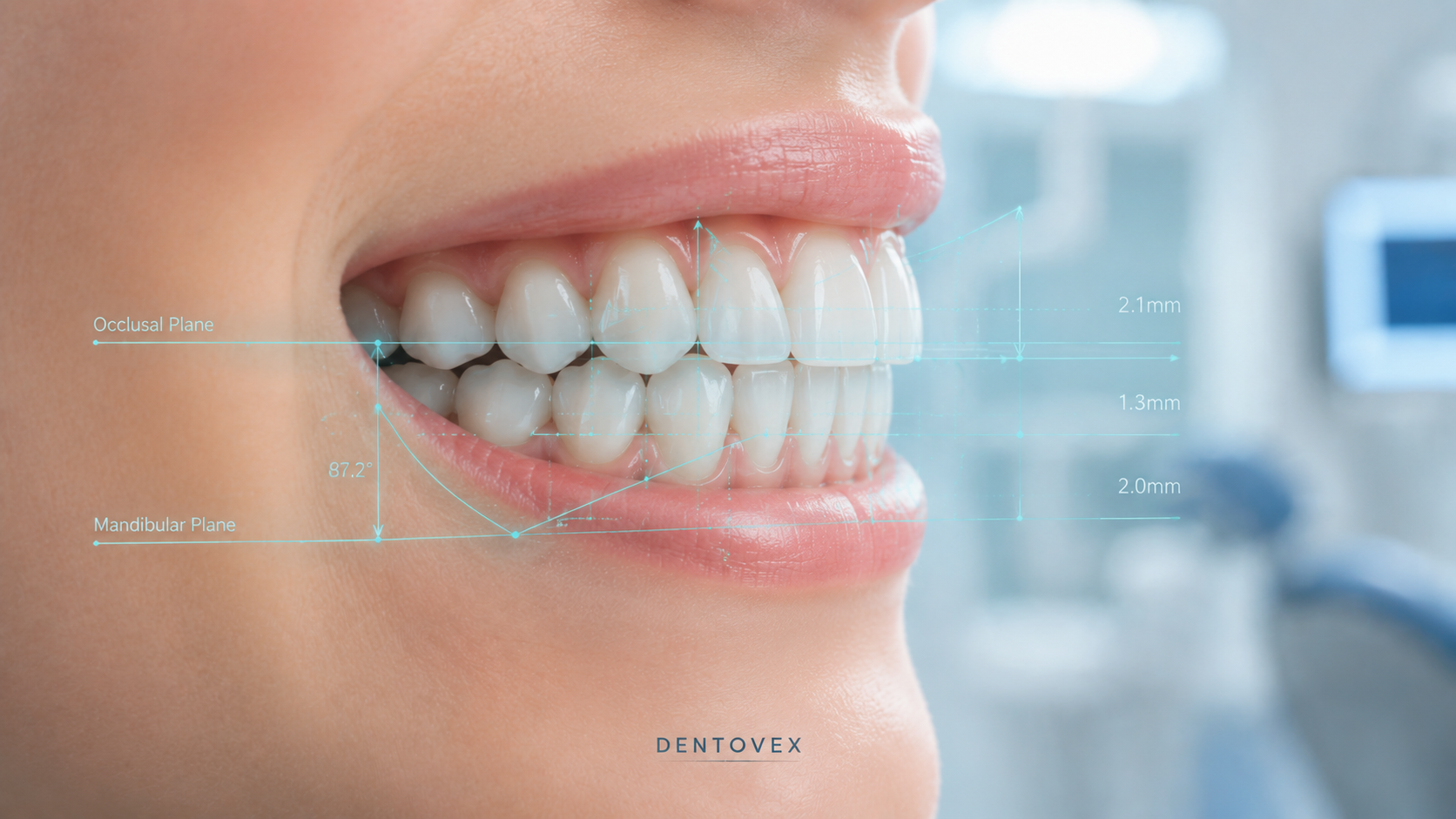
The Evolutionary Shift in Bite Management In the realm of advanced craniofacial engineering, few structural discrepancies require as much tactical precision as an open bite. Defined simply as a malocclusion where the upper and lower teeth cannot make physical contact when the jaw is fully closed, this condition leaves an immediate gap in the smile line.
Historically, treating a severe adult open bite was one of the most dreaded conversations in a dental clinic. If the root cause was skeletal meaning the jaw bones grew vertically mismatched the standard clinical verdict was almost always invasive maxillo-mandibular advancement surgery (orthognathic surgery).
However, modern technology has radically transformed our clinical capabilities. In our previous overview, we introduced how this condition impacts overall dental health. In this deep-dive guide, we will analyze the precise biomechanical forces, state-of-the-art non-surgical tools, and custom stabilization protocols that allow specialists to close the gap reliably and preserve your long-term masticatory (chewing) function.
1. The Biomechanical Blueprint: Dental vs. Skeletal Realities
To map out a successful correction strategy, a clinician must first isolate where the structural failure resides. This requires a three-dimensional evaluation using digital Cone Beam Computed Tomography (CBCT) to measure the underlying skeletal angles.
Dental Open Bites
These are localized discrepancies confined strictly to the teeth and alveolar bone. The jaw bases themselves are perfectly proportioned, but habits like chronic tongue thrusting or prolonged pacifier use have physically tipped the front teeth outward and upward. Dental variations are highly responsive to conventional orthodontic forces.
Skeletal Open Bites
These are rooted deep within the facial morphology. The posterior (back) dentoalveolar segments are typically over-erupted, causing the mandible to rotate downward and backward. This creates a long lower facial height and makes it structurally impossible for the front teeth to meet. Closing a skeletal gap without surgery requires highly creative mechanical manipulation.
2. Non-Surgical Open Bite Breakthroughs
The integration of temporary structural anchorage and specialized clear aligner staging has made non-surgical open bite closure highly predictable. Here are the core modern modalities utilized to redirect your bite mechanics:
A. Molar Intrusion via TADs (Temporary Anchorage Devices)
Instead of trying to pull the front teeth down over an massive distance which can destabilize their roots the ultimate strategy is to push the back molars up into the bone. This is called posterior intrusion.
[Posterior Molars Intruded Upward via TADs] ➔ [Mandible Rotates Up and Forward] ➔ [Anterior Open Bite Closes Naturally]
By placing microscopic, sterile titanium mini-screws (TADs) into the palatal bone, your orthodontist creates an immovable anchor point. A light, continuous elastic upward force is applied to the molars. As the back teeth move upward by just 1 to 2 millimeters, it triggers a powerful geometric shift: the entire lower jaw rotates upward and forward, causing the front teeth to close together naturally without surgical intervention.
B. Specialized Clear Aligner Mechanics
Clear aligners are exceptionally efficient at handling open bite cases due to their structural coverage. Because the plastic completely envelops the biting surfaces of all teeth, it acts as a built-in bite block, preventing the back teeth from over-erupting during treatment.
By pairing sequential aligner setups with precisely calibrated vertical attachments and micro-elastics, clinicians can introduce highly localized vertical movements to guide the incisors into a healthy, stable overlap.
3. The Neuromuscular Component: Myofunctional Therapy
You can deploy the most advanced clear aligners or surgical protocols available, but if your tongue continues to slam forward into the teeth thousands of times a day during swallowing, your correction will fail. The soft tissues will always win against bone over time.
True open bite correction requires a dual-phase approach:
- The Structural Phase: Braces, aligners, or TADs move the hard tissues into alignment.
- The Functional Phase: Myofunctional therapy retrains the swallowing reflex, teaches the tongue to rest naturally against the roof of the mouth (the palatal spot), and strengthens the lip seal muscles.
Integrating a certified myofunctional specialist into your orthodontic timeline is the absolute single best insurance policy against long-term open bite relapse.
4. Transitioning into Long-Term Active Retention
Because open bites carry a notoriously high biological relapse rate, your post-treatment retention blueprint must be flawless. Once the front teeth achieve an ideal contact relationship, the surrounding periodontal fibers remain highly unstable for months.
To lock this relationship in place, a hybrid defense framework is highly recommended:
- Fixed Lingual Retainers: A passive stainless-steel wire is bonded permanently behind the upper and lower front teeth from canine to canine, physically blocking any immediate forward movement.
- Premium Thermoplastic Overlays: Custom-molded Invisalign Vivera retainers are worn over the arches during sleep. Because these trays provide full occlusal coverage, they continuously prevent the back molars from drifting vertically, maintaining the strict spatial parameters achieved during active care.
Conclusion: Redefining Your Bite Dynamics An open bite is a complex neuromuscular and skeletal puzzle, but it is entirely solvable. Whether your condition requires conservative clear aligner guidance, precision molar intrusion via titanium TADs, or a coordinated surgical-orthodontic plan, taking the step to close the gap safeguards your entire oral ecosystem from destructive, asymmetric wear.
Do not allow the structural complexity of an open bite to delay your care. By pairing advanced digital imaging with dedicated myofunctional training, you can achieve a functional, balanced bite and an unshakeable, healthy smile line that lasts a lifetime.
Disclaimer: Open bite anomalies require extensive diagnostic classification. Always prioritize a comprehensive face-to-face clinical exam and 3D CBCT screening by a licensed orthodontic specialist before initiating any active force application.
No responses yet