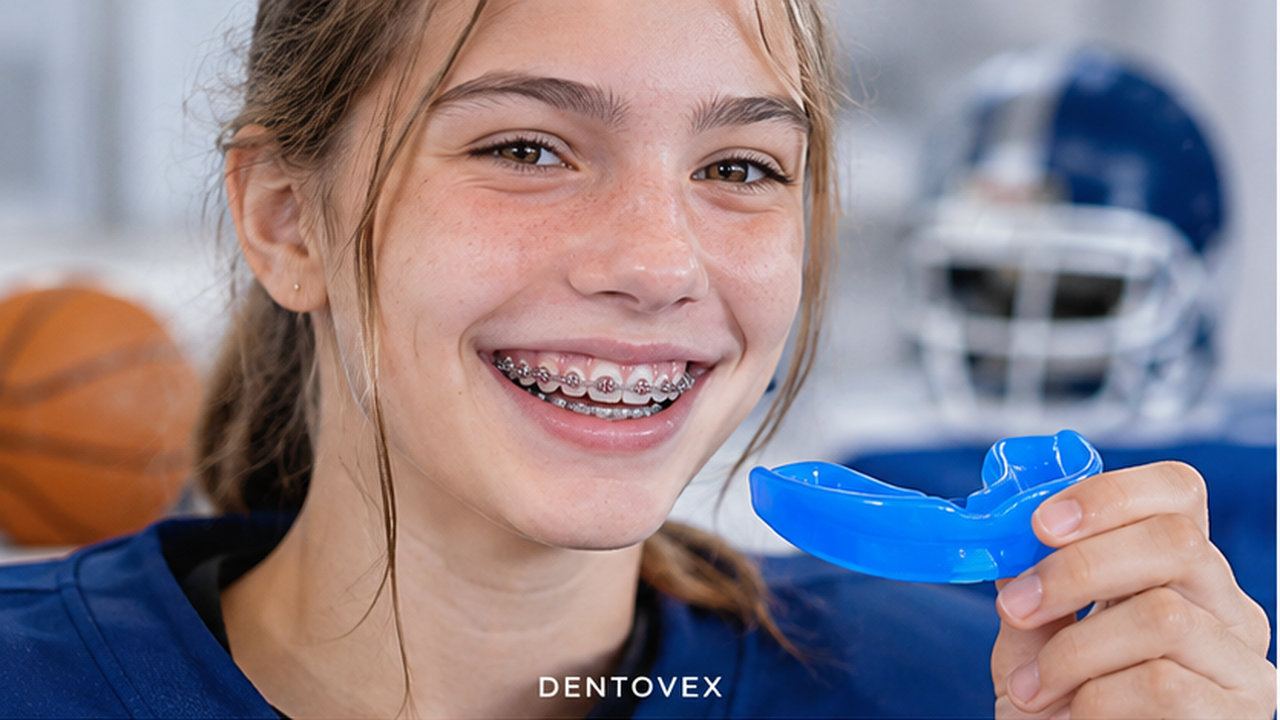
Quick answer: Yes, you can play sports with braces, and a correctly fitted sports mouthguard is particularly important when there is a risk of a blow to the face. Your guard should protect both your teeth and the soft tissues around brackets and wires. Because teeth move during orthodontic treatment, a guard that fit last month may not fit well today. Ask your orthodontist to help select and reassess it.
A ball, elbow, or accidental fall can injure teeth even in sports that are not traditionally described as “contact sports.” Braces add another concern: brackets and wires may press into the cheeks or lips during an impact. A mouthguard is not an invisible shield or a guarantee against injury, but professional dental organizations recommend well-fitting guards for activities with oral-injury risk. The American Dental Association emphasizes fit, retention and consistent wear; the American Association of Orthodontists specifically encourages orthodontic patients to discuss guard selection with their orthodontist.
Why a regular mouthguard may not work over braces
Sports mouthguards need to remain seated without constant clenching. A guard that is too tight can press on brackets or interfere with the movement of teeth; one that is loose may slip during play. A guard that covers only a small portion of the teeth may leave areas exposed. Fixed appliances create extra contours and, as an active treatment progresses, those contours change. The right choice is therefore based on fit and supervision, not solely on a package label such as “best for braces.”
A sports mouthguard is different from a night guard prescribed for grinding. Do not substitute one for the other unless a dental professional approves the design and intended use.
Mouthguard choices for patients with braces
| Type | What makes it useful | Trade-offs to discuss |
|---|---|---|
| Orthodontist-made custom guard | Professionally assessed fit, coverage, and comfort | Costs more and may need refitting or replacement as teeth move |
| Orthodontic-specific ready-to-wear guard | May have extra space intended to accommodate fixed appliances | Must still stay in place securely and comfortably; one size does not fit all |
| Mouth-formed “boil-and-bite” guard | Can be adapted to an individual’s dental arch when used correctly | Incorrect molding or overly tight fit may be a problem with fixed braces; ask for professional fitting advice |
| Basic stock guard | Widely available | The ADA notes that many stock guards fit poorly and may require biting down to hold them in place |
The ADA explains these general categories in its mouth protector evidence summary. No product in this article has been purchased, fitted, or independently performance-tested by Dentovex. We are comparing categories, not claiming a commercial winner.
Is a boil-and-bite guard safe with braces?
Some mouth-formed guards can be used in orthodontic patients, but the decision depends on the design and how it is fitted. Do not force hot, softened material tightly into brackets or attempt to remodel a guard against your fixed appliances without advice. Follow the manufacturer’s instructions and ask your orthodontist to confirm it does not catch on your braces or apply unwanted pressure. A “braces-compatible” marketing label does not replace a real fitting check.
Upper guard or upper and lower guards?
Some guards are designed for the upper arch, while certain sports or appliance arrangements may require protection on both arches. ADA MouthHealthy advises that an orthodontist may suggest lower-arch protection when braces are present there. Do not assume both arches need identical devices, or that a double guard is automatically better.
Five checks before taking a guard onto the field
- Retention: Does the guard stay in place when you open your mouth normally, without biting down continuously?
- Comfort: Does it avoid cutting into your gums and cheeks or pinching fixed braces?
- Breathing and speaking: Can you breathe normally and communicate reasonably clearly while wearing it?
- Coverage: Does it protect the relevant teeth and soft tissues, as advised by your dental professional?
- Current fit: Has the guard been checked since recent bracket changes, alignments, or growth?
These are conversation points for a fitting appointment not a home certification test. If a guard falls out, feels sharp, or presses hard against a moving tooth, stop using it and ask for a fitting assessment.
Which sports call for a mouthguard?
The ADA identifies activities ranging from football, hockey and basketball to cycling, gymnastics and skateboarding as examples of sports with oral injury potential. Rules vary by league, age, school, and sport; your coach can explain any required equipment, but the dental fit decision belongs with your clinician. The American Academy of Pediatric Dentistry encourages appropriately fitted mouthguards in organized activities that pose oral injury risk.
| Activity situation | Practical approach |
|---|---|
| Collision or contact sport | Wear an approved, well-fitting sports guard every practice and game; follow league rules |
| Ball sport with accidental elbow or ball strikes | Ask your orthodontist about a guard even when league rules do not require one |
| Cycling, skateboarding or high-velocity activity | Consider mouth protection along with the sport-specific helmet and other safety equipment |
| Guard does not fit after orthodontic adjustment | Arrange a reassessment instead of forcing the old guard into place |
Caring for your mouthguard without damaging it
Rinse the guard before and after use. Clean it as the manufacturer and your dental professional recommend; cool water and gentle cleaning are commonly appropriate. Let it dry and keep it in a ventilated protective case. Avoid leaving it in hot cars, direct sun or very hot water, where some materials may distort. Bring it to dental appointments so its fit and condition can be checked. Replace it when it becomes damaged, ill-fitting, or excessively worn. These points follow the ADA patient guidance.
Braces hygiene still matters: a guard does not replace careful brushing or cleaning around brackets. See the Dentovex guide to cleaning braces for a separate oral-care routine.
What if a player is hit in the mouth?
Stop play and assess the injury. Bleeding that will not stop, trouble breathing or swallowing, major facial trauma, or a knocked-out permanent tooth needs urgent medical or emergency dental care. A suspected concussion also needs prompt medical evaluation. If a bracket breaks or a wire shifts but there is no medical emergency, contact your orthodontist for instructions and avoid trying to repair brackets yourself. Keep any loose pieces safely if you can do so without risk of swallowing them. The Dentovex braces emergency guide covers common appliance problems, while AAO emergency guidance distinguishes urgent injuries from minor appliance discomfort.
If a metal edge rubs your cheek afterward, your orthodontist may suggest temporary orthodontic wax. The wax guide explains that separate comfort measure; it is not protection from a sports impact.
A practical shopping checklist not a product ranking
Before buying, write down the sport, whether braces are on one or both arches, the date of the next adjustment, and the type of device recommended by your orthodontist. Look for clear fitting instructions, materials and care information, a return or replacement policy, and a manufacturer who explicitly addresses orthodontic use. If you are considering an ADA Seal-accepted product, check the current accepted-products list rather than assuming any logo or marketplace claim is legitimate. Avoid treating a high star rating as proof that a guard fits your specific orthodontic appliances.
Frequently asked questions
Can you wear a mouthguard over metal braces?
Yes, if it is the right style and fits appropriately. Your orthodontist can help evaluate whether it accommodates the brackets and wires without excessive pressure.
Do braces themselves protect teeth in sports?
No. Brackets and wires are treatment hardware, not protective sports equipment. They can add soft-tissue injury concerns if the mouth receives an impact.
Is a custom mouthguard always necessary?
Not always. Fit, sport, orthodontic stage, comfort and your clinician’s guidance determine the appropriate option. Custom guards can be helpful but are not the only conceivable option.
Can I keep using one mouthguard for the entire braces treatment?
Do not assume so. Teeth change position during treatment; children and teens may also grow. Inspect the guard and have its fit reviewed after meaningful dental changes.
Should I wear my retainer during contact sports?
The ADA advises removing retainers and other removable orthodontic appliances during contact sports. Confirm the plan for your particular appliance with your orthodontist.
Can a sports mouthguard also treat nighttime teeth grinding?
A sports mouthguard and a professionally prescribed night appliance have different purposes. Ask a clinician before using either for an unintended purpose.
What if my braces-friendly mouthguard hurts?
Discontinue use of a guard that pinches, cuts, or puts uncomfortable pressure on your teeth or braces and contact your orthodontic team. Do not force it to fit.
Key takeaways
A safe mouthguard decision is less about choosing the most expensive product and more about fit, sport, correct use, cleaning and replacement as orthodontic treatment changes. A well-fitting guard should be an essential part of the sports equipment conversation for athletes with braces. Pair that planning with the broader Dentovex guide to sports and daily life with braces.
Medical information notice: This educational article is not a diagnosis, a product certification, or individual fitting advice. An orthodontist or dentist must assess the best mouthguard for your teeth, braces and sport. In an emergency, seek urgent medical/dental care.
No responses yet