The Role of Extraoral Anchorage in Orthodontics
Achieving optimal orthodontic balance involves more than shifting individual teeth within the dental arches. In complex skeletal malocclusions, the underlying growth relationship between the upper maxilla and lower mandible must be redirected. While intraoral appliances such as braces, aligners, and springs manipulate individual teeth effectively, certain severe skeletal discrepancies require extraoral force. This is where orthodontic headgear plays an essential clinical role.
Orthodontic headgear refers to a specialized category of extraoral appliances designed to modify jaw growth, move entire molar segments backward, or pull the upper jaw forward during peak developmental years. By anchoring to external structures like the back of the neck or the crown of the head, extraoral appliances deliver precise physical forces that intraoral anchors alone cannot achieve without unwanted tooth displacement.
At Dentovex, our clinical specialists carefully evaluate skeletal growth patterns using digital cephalometric analysis to determine when extraoral anchorage is required. In this master guide, we break down the biomechanics of orthodontic headgear, evaluate the primary appliance types, discuss compliance protocols, and outline safety guidelines for long-term facial balance.
1. Biomechanical Mechanics: How Extraoral Anchorage Works
Orthodontic tooth movement relies on Newton’s third law of motion: every action creates an equal and opposite reaction. When an orthodontist attempts to push upper molars backward using intraoral springs, an equal pushing force pushes front teeth forward. This unwanted forward movement is known as a loss of intraoral anchorage.
Extraoral Anchorage versus Intraoral Anchorage
Extraoral appliances solve this mechanical challenge by anchoring outside the mouth. By taking support from dense cranial bones or the stable cervical spine, headgear delivers directional vector forces to the upper jaw without placing reciprocal reactive stress on other teeth.
Skeletal Growth Modification versus Dental Movement
Headgear operates through two distinct mechanical objectives depending on patient age and force magnitude:
- Orthopedic Force (High Magnitude): Heavy forces applied during growth periods restrain or redirect jaw bone development. For example, orthopedic headgear can slow down upper jaw forward growth in a child with a severely protruding upper jaw.
- Orthodontic Force (Light to Moderate Magnitude): Lighter forces applied over longer daily periods move individual upper molars backward through the alveolar bone to create space for crowded teeth.
2. Comparing Types of Orthodontic Headgear
Extraoral appliances are classified by the direction of force vector they produce and the specific bite discrepancy they correct:
| Headgear Type | Anchorage Area | Direction of Force Vector | Primary Clinical Application |
| Cervical Pull Headgear | Back of the neck (cervical strap). | Backward and slightly downward. | Class II correction in patients with low vertical facial heights or deep bites. |
| High Pull Headgear | Crown/top of the head (parietal strap). | Backward and upward. | Class II correction in patients with high vertical facial heights or open bites. |
| Straight/Combination Pull | Neck and top of head combined. | Directly backward along the occlusal plane. | Parallel molar distalization without changing vertical bite height. |
| Reverse Pull Face Mask | Forehead and chin pads. | Forward (protraction). | Class III skeletal correction (underbites) by pulling upper jaw forward. |
3. Clinical Indications Across Skeletal Malocclusions
Extraoral headgear is customized based on specific structural growth needs identified during diagnostic planning:
Class II Division 1 (Overbite)  ──> Cervical or High Pull Headgear (Restrains upper jaw)
                                                │
Class III Malocclusion (Underbite) ──> Reverse Pull Face Mask (Pulls upper jaw forward)
                                                │
Molar Space Maintenance        ──> Straight Pull Anchorage (Holds molars stationary)
Class II Correction (Overjet and Overbite)
In Class II malocclusions, the upper jaw sits too far forward relative to the lower jaw. Cervical or high pull headgear restrains forward upper jaw growth while allowing the lower jaw to grow forward naturally into a balanced profile. Additionally, it pushes upper molars backward, creating valuable space to relieve front tooth crowding without requiring permanent tooth extractions.
Class III Correction (Underbites)
In Class III malocclusions, the upper jaw is underdeveloped or set too far back relative to a prominent lower jaw. A reverse pull face mask rests on the forehead and chin, using intraoral elastics attached to a upper orthodontic expander to pull the upper jaw forward into a healthy bite relationship.
4. The Clinical Workflow for Headgear Therapy
Fitting and monitoring extraoral appliances requires careful adjustments to protect soft tissues and ensure precise force vectors:
1.1. Cephalometric & Facial Analysis:Evaluating bone vectors and growth.
Lateral cephalometric X-rays and 3D intraoral scans determine whether bite issues stem from tooth position or underlying jaw skeletal growth.
2.2. Molar Band & Facebow Fitting:Setting up internal anchors.
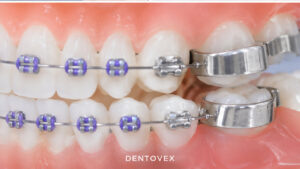
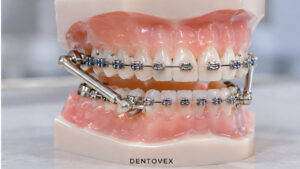
Precision metal bands with outer headgear tubes are fitted to upper back molars. An inner facebow wire inserts into these molar tubes smoothly.
3.3. Extraoral Strap Calibration:Calibrating force magnitudes.
The external headgear strap (cervical, high pull, or face mask) is attached to the facebow arms. A tension gauge calibrates elastic force vectors accurately.
4.4. Wear Schedule & Monitoring:Guiding active orthopedic movement.
The patient wears the appliance at home for the prescribed daily duration (typically 12 to 14 hours), with monthly safety and progress checks.
5.5. Appliance Removal & Intraoral Detailing:Transitioning to intraoral alignment.
Once skeletal targets are met, extraoral wear stops. Treatment transitions to fixed adult braces or clear aligners to complete alignment.
5. Daily Compliance, Safety Protocols, and Adaptation
Wearing orthodontic headgear requires adherence to safety protocols and daily routine consistency.
Daily Wear Duration (12 to 14 Hours Rule)
To achieve effective bone remodeling, extraoral headgear must be worn for 12 to 14 hours per day. Because wearing headgear during school or work is impractical, patients complete their prescribed hours by wearing the appliance immediately after school, throughout the evening, and while sleeping. Consistency is critical; skipping days resets tissue response, extending overall treatment duration.
Essential Safety Guidelines
Modern orthodontic headgear utilizes safety-release modules designed to prevent accidental facebow snap-back injuries:
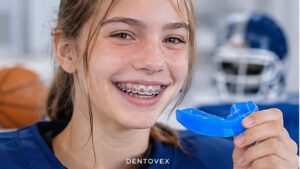
- Never Wear Headgear During Active Play: Extraoral appliances must be removed during sports, running, or rough play to prevent accidental facial trauma.
- Always Disengage Straps First: When removing the appliance, unhook the extraoral neck or head strap before pulling the facebow wire out of the mouth. Never pull the facebow out while straps are under tension.
- Proper Facebow Positioning: The outer bow arms should sit approximately 1 to 2 millimeters away from the cheeks to prevent skin pressure marks.
Comfort Adjustments
Tenderness in the back molars is normal during the first 3 to 5 days of headgear wear as teeth adapt to orthopedic forces. Over-the-counter pain relievers ease initial discomfort. If metal facebow arms rub against the inner lips, applying medical-grade orthodontic wax provides immediate relief.
6. Long-Term Facial Harmony and Treatment Value
Using extraoral headgear during peak growth years can eliminate the need for corrective jaw surgery or permanent tooth extractions later in life. By addressing skeletal imbalances early, orthodontists guide natural growth into a functional, harmonious facial profile.
Detailed financial breakdowns for interceptive extraoral appliances are detailed in our cost of braces overview. Following active bite correction, custom orthodontic retainers maintain stable skeletal and dental relationships long term.
Conclusion: Precision Extraoral Control for Complex Bites
Orthodontic headgear remains one of the most mechanically effective tools for correcting severe skeletal jaw imbalances. By applying directional forces from extraoral anchorage points, headgear guides facial growth, creates necessary space, and delivers lasting bite stability.
Disclaimer: Orthodontic headgear treatment suitability depends on patient growth phase, skeletal maturity, and compliance. Always consult a licensed orthodontic specialist for a complete diagnostic evaluation.
No responses yet