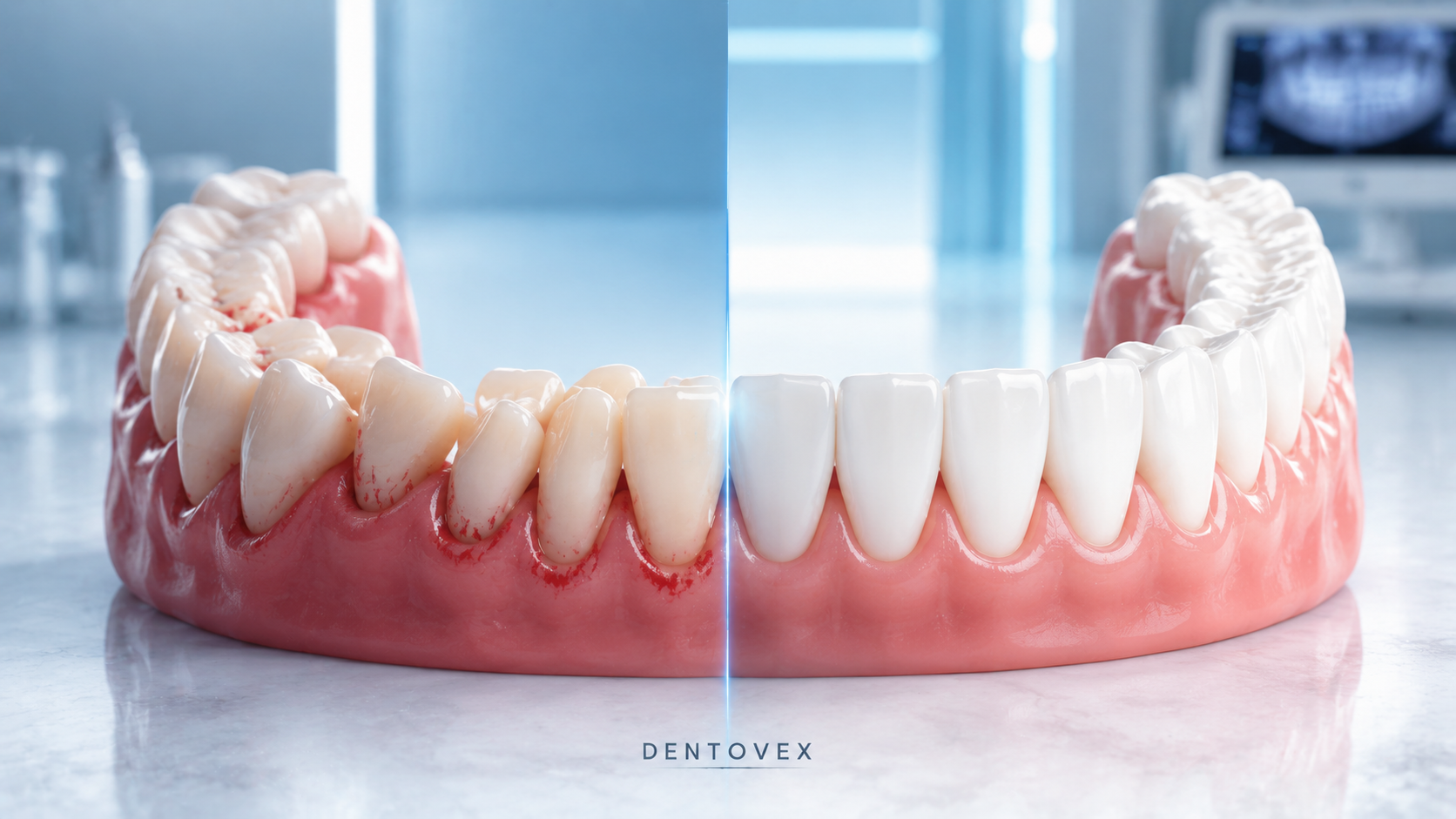
The Spatial Puzzle of the Human Jaw When teeth develop beautifully aligned, it is a perfect harmony of genetics, bone development, and muscle function. However, for a vast majority of adults and children, that harmony is disrupted by a very common structural mathematical problem: teeth crowding.
Dental crowding occurs simply when there is not enough space within the jawbone perimeter to accommodate the total structural width of your adult teeth. As a result, teeth are forced to twist, overlap, push forward, or recede backward just to fit inside your mouth.
At Dentovex, we encounter patients daily who view crowding purely as a visual blemish they wish to hide in photographs. Clinically, however, crowded teeth represent a silent threat to your long-term oral ecosystem. In this foundational guide, we analyze the physiological triggers behind teeth crowding, the invisible health risks it creates, and the sophisticated treatment pathways available to restore systemic balance to your bite.
1. What Triggers Teeth Crowding?
Crowding rarely happens overnight. It is typically the culmination of developmental factors, genetic architecture, and functional lifestyle habits.
- Genetic Discrepancy: The most common cause is inheriting a small jaw size from one parent and large teeth from the other. No amount of perfect oral hygiene can alter this fundamental skeletal blueprint.
- Late-Stage Mandibular Growth: As humans transition through their late teens and early twenties, the lower jaw (mandible) naturally undergoes a final phase of forward growth. If the upper teeth act as a rigid barrier, this natural shift can compress the lower front teeth, causing sudden “late-stage crowding.”
- Premature Loss of Primary Teeth: If a child loses a baby tooth early due to decay or trauma, the surrounding teeth will naturally drift forward into that empty space. When the larger adult tooth finally tries to erupt, its designated highway is blocked, forcing it to emerge rotated or out of alignment.
- Myofunctional Habits: Chronic thumb-sucking, mouth-breathing, or an improper resting tongue posture can exert subtle, continuous muscular forces that narrow the dental arches over time.
2. The Hidden Medical Risks of Leaving Crowding Untreated
While a straight smile provides an undeniable psychological boost, correcting crowded teeth is a fundamental medical necessity. When teeth overlap, they create tight, inaccessible architectural dead-zones that lead to specific pathologies:
A. Accelerated Periodontal Disease
Even the most meticulous brushes and expensive water flossers cannot physically navigate every microscopic crevice created by severely overlapped enamel. Plaque and food remnants calcify into tartar (calculus) in these zones, initiating pregnancy gingivitis-like inflammation or chronic periodontitis. This slowly destroys the underlying bone supporting your roots.
B. Asymmetric Enamel Wear and Tear
A healthy bite distributes masticatory (chewing) forces evenly across all teeth. When teeth crowding forces individual elements out of alignment, certain teeth endure a disproportionate mechanical load. This leads to premature chipping, fractured cusps, and localized enamel erosion.
C. Chronic Halitosis (Bad Breath)
Because crowded dental arches house permanent bacterial reservoirs that resist normal cleaning routines, patients frequently battle chronic halitosis that cannot be resolved with mouthwash alone.
3. How Modern Orthodontics Resolves Teeth Crowding
The days of automatically extracting healthy teeth to make room for alignment are gone. Modern orthodontics deploys conservative, biomechanically advanced approaches to expand your arch perimeter safely.
A. Non-Extraction Arch Expansion
For mild-to-moderate teeth crowding, specialized archwires or sequential clear aligner templates apply a light, continuous lateral force. This coaxes the teeth outwards, broadening the dental arch slightly. This expansion creates the missing millimeters needed to un-crowd the smile line while providing excellent lip and facial profile support.
B. Interproximal Reduction (IPR)
When space limitations are specific to certain zones, clinicians utilize interproximal reduction. By carefully polishing a fraction of a millimeter (0.2mm to 0.5mm) from the outer enamel borders where adjacent teeth touch, we generate exact clear pathways for crowded teeth to pivot into alignment smoothly without changing the overall jaw width.
C. Customized Fixed and Removable Systems
Depending on the severity and patient preference, crowding is corrected using:
- High-Tech Fixed Braces: Utilizing low-profile ceramic or metal brackets that allow for highly intricate root torqueing and structural rotation.
- Clear Aligner Sequences: Providing near-invisible management of dental crowding by shifting teeth through pre-programmed digital stages.
4. The Lifelong Rule: Safeguarding Your Space
Once your teeth crowding is successfully corrected, the journey enters its most vital phase: Permanent Retention.
Because your jawbone structure naturally narrows slightly as a normal part of the human aging process, un-crowded teeth will always possess an anatomical tendency to drift back toward an overlapped state. Protecting your investment requires an unwavering commitment to a long-term retention framework—using custom Invisalign Vivera retainers or a fixed, bonded wire behind your front teeth to lock your healthy, spacious alignment in place permanently.
Conclusion: Reclaiming Your Alignment Teeth crowding is far more than an aesthetic inconvenience; it is a mechanical imbalance that compromises your entire oral health ecosystem over time. Fortunately, modern diagnostic imaging, sophisticated digital planning, and biological tissue modeling mean that resolving crowding is more predictable, comfortable, and conservative than ever before.
If you are tired of struggling to floss between crowded teeth or hiding your smile in social settings, the solution begins with a detailed orthodontic consultation. Taking the step to align your teeth today protects the functional longevity of your bite for decades to come.
Disclaimer: Dental crowding severity varies wildly between individuals. Safe correction requires full diagnostic digital radiographs and a clinical evaluation by a board-certified orthodontic specialist to prevent root resorption or periodontal damage.
No responses yet