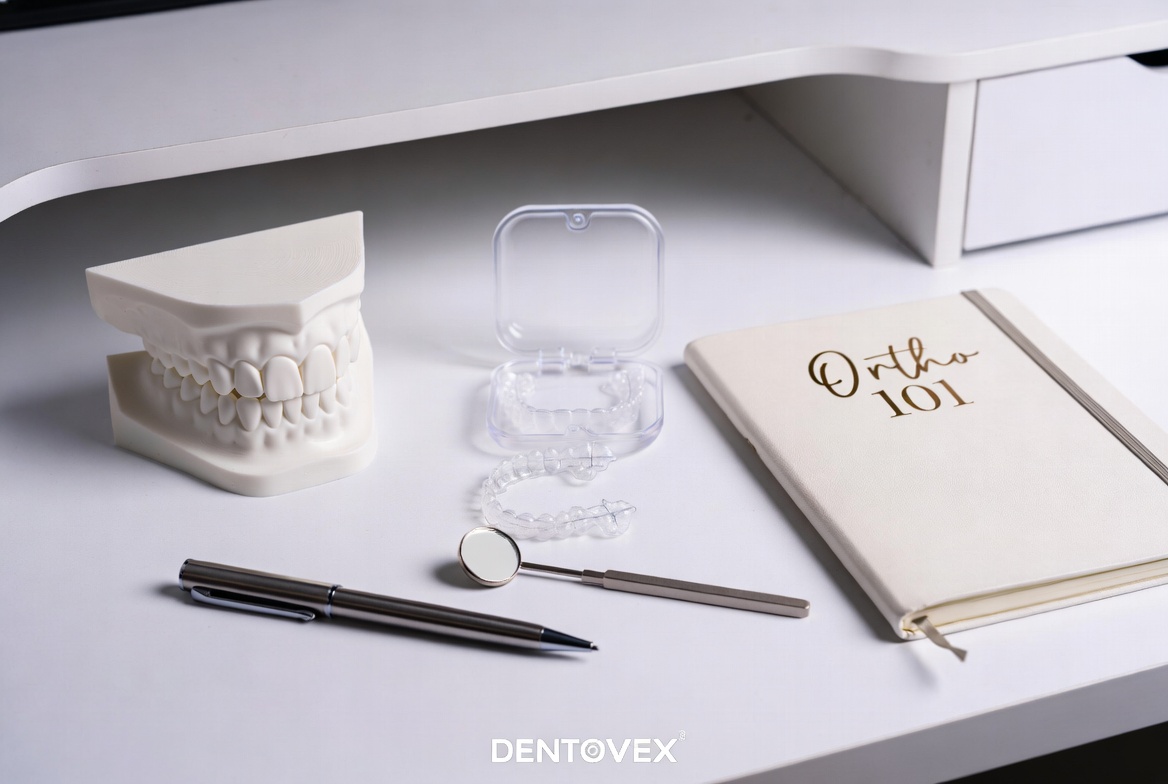
Introduction: The “Ortho” World, Simplified If you’ve recently been told by your dentist that you need “orthodontic intervention,” you might feel like you’ve suddenly walked into a room where everyone is speaking a different language. Between the terms “malocclusion,” “archwires,” and “tracking,” it’s easy to feel overwhelmed. At Dentovex, we believe that the best patient is an informed patient.
Welcome to Ortho 101 your foundational guide to everything you need to know about straightening your teeth. Whether you’re a parent exploring options for a child or an adult looking to reclaim your own smile, this guide strips away the clinical jargon and gives you the honest, clear truth about how orthodontics works in 2026.
1. What Exactly is Orthodontics?
At its core, orthodontics is a specialized branch of dentistry focused on the diagnosis, prevention, and correction of misaligned teeth and jaws. It isn’t just about the “Hollywood smile.” It’s about function. When teeth are misaligned what we call “malocclusion” they can cause a domino effect: uneven wear on enamel, chronic jaw pain, difficulty in cleaning (leading to gum disease), and even speech impediments. Orthodontics is the science of correcting the “scaffolding” of your bite to ensure your teeth last a lifetime.
2. The Mechanics: How Teeth Move
Many people ask: “How can a piece of metal or plastic move a bone?” The answer is biology. Your teeth are not set in your jawbone like fence posts in concrete. They are held in place by the periodontal ligament. When we apply a light, consistent force, it triggers a biological process called “bone remodeling.”
Think of it this way: the side of the tooth that is being “pushed” experiences pressure, causing the bone to gently resorb (dissolve), while the side that is being “pulled” experiences tension, causing new bone to be deposited. This is why orthodontics cannot be rushed. If you apply too much force, you risk damaging the root. This is the art of Ortho 101: the perfect balance between biology and mechanical pressure.
3. The Main Players: Braces vs. Aligners
In 2026, the playing field has leveled, but the choice between the two is still a major decision.
- Traditional Braces: The “heavy lifters.” Whether they are metal or ceramic (tooth-colored), they are attached to your teeth 24/7. They provide the orthodontist with constant control. For complex bite corrections, severe rotations, or cases requiring extractions, braces remain the clinical gold standard.
- Clear Aligners: The “lifestyle” choice. These are removable, custom-made plastic trays. They are nearly invisible and much easier to clean. However, they rely 100% on your discipline. If you don’t wear them for 22 hours a day, the treatment stops.
4. Understanding Your Orthodontic Timeline
The most common question in our clinic is: “How long will this take?” For most standard cases in 2026, you are looking at a timeframe of 12 to 24 months. However, this depends on:
- Biological Response: Every person’s metabolism is different.
- Complexity: Closing a small gap is vastly different from correcting a skeletal overbite.
- Compliance: Every time you miss an appointment or “forget” to wear your aligners, you add time to your treatment.
5. The “Ortho 101” Dictionary: Terms You Should Know
To help you talk to your orthodontist like a pro, here are the terms you’ll hear most often:
- Malocclusion: A fancy way of saying “bad bite.”
- Archwire: The metal wire that acts as the “track” along which your teeth move.
- IPR (Interproximal Reduction): A technique where we gently polish a tiny fraction of enamel between teeth to create space for alignment, don’t worry, it’s painless!
- Tracking: A term used primarily for aligners, meaning your teeth are moving exactly as the computer model predicted.
- Bonding: The process of attaching brackets to your teeth.
6. Maintenance: Life During Treatment
Living with orthodontic hardware requires a shift in your daily habits.
- Hygiene: Your biggest enemy is “plaque trap.” If you don’t clean meticulously, you risk white spots (decalcification) on your teeth once the hardware is removed.
- Diet: If you have braces, you must avoid the “Sticky, Hard, and Crunchy” trio (caramels, nuts, and baguette crusts). If you have aligners, remember the “Remove to Eat, Brush to Replace” rule.
7. The Retention Phase: Why You’re Never Really “Done”
In our previous guides, we’ve emphasized this, but it bears repeating in our Ortho 101 syllabus: Retention is for life. Once your teeth are straight, they will always want to shift back to their original position due to the memory of the periodontal ligaments. Your retainers are your insurance policy. Treat them with respect, keep them clean, and wear them as prescribed.
Conclusion: Ready to Start? The orthodontic journey is a significant commitment of time, money, and effort. But the result a functional, healthy, and beautiful smile is a lifelong asset. Now that you have the Ortho 101 basics, you are better equipped to have a productive, high-level conversation with your clinician. Remember, there is no “stupid question” when it comes to your health. Ask your orthodontist about the digital planning, the expected timeline, and the retention strategy before you sign your treatment plan.
Disclaimer: This guide is meant to simplify orthodontic concepts. Every patient’s biology is unique; always prioritize the personalized treatment plan provided by your licensed orthodontist.
No responses yet