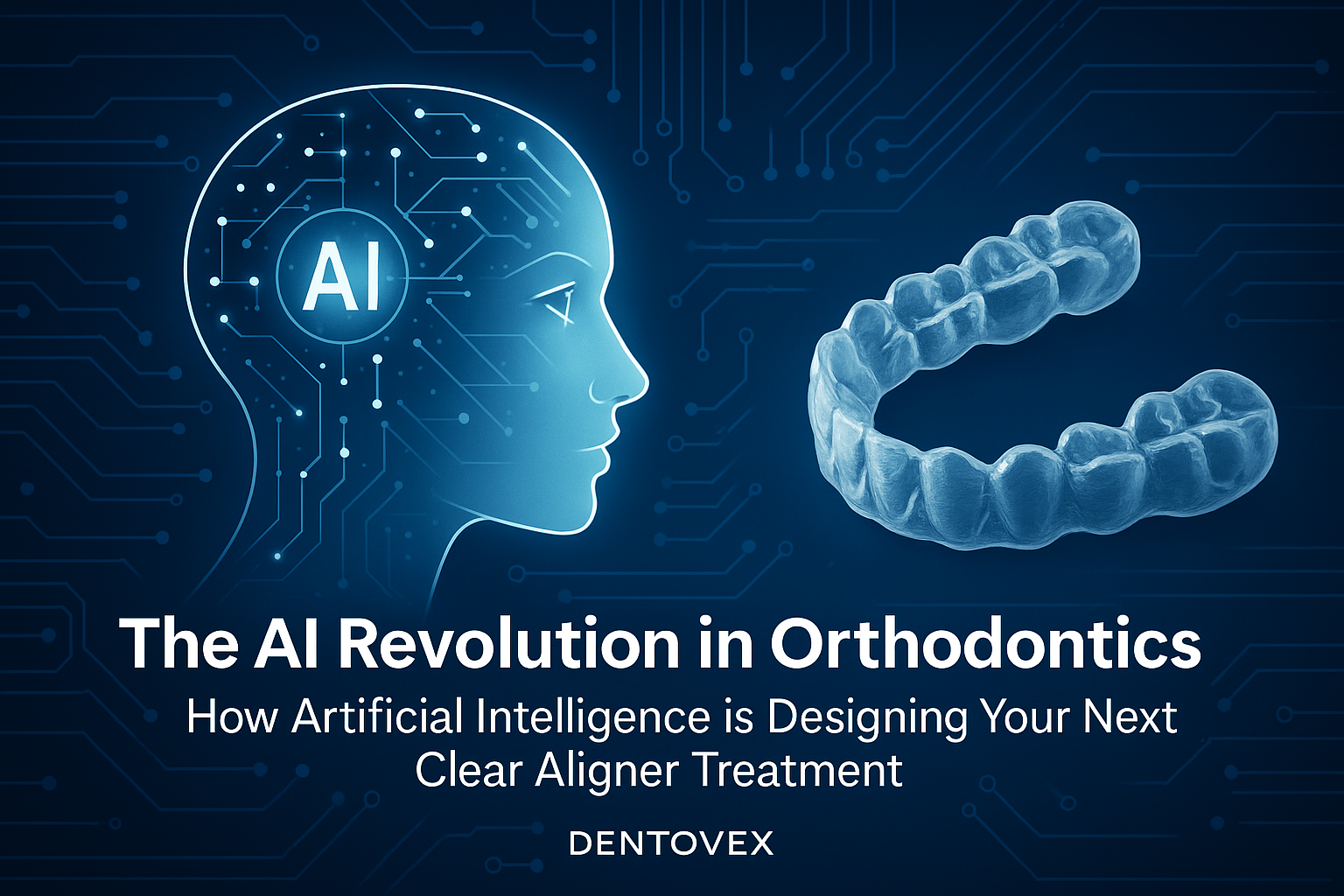
When you first decided to get clear aligners, you probably thought the process involved a simple scan and then magic. While the results often feel like magic, the planning stage is incredibly complex. Historically, an orthodontist spent hours analyzing X-rays, models, and photos to map out every single millimeter of tooth movement.
Today, that entire process is being turbocharged by Artificial Intelligence (AI).
AI in orthodontics is not science fiction it is the modern reality. It’s a tool that helps your doctor diagnose faster, predict results more accurately, and reduce the chance of errors, leading to shorter and more efficient treatment for you.
At Dentovex, we believe in transparency about the technology shaping your treatment. Here is how machine learning is revolutionizing the world of clear aligners.
1. AI in Diagnosis: The Power of Pattern Recognition
The human eye is fantastic, but AI is better at spotting tiny, subtle patterns across thousands of different patient cases.
A. Faster, More Accurate Cephalometric Analysis
- What it is: A cephalometric X-ray is a side-view skull image used to measure the angles of the jaw and teeth. This is crucial for planning bite correction.
- The AI Advantage: AI software can analyze and trace these anatomical points (like the jaw joint, nasal bone, and chin) in seconds, a task that used to take an orthodontist 10-20 minutes. This eliminates human error and provides an immediate, standardized diagnosis.
B. Predicting Root Movement The most complex part of orthodontics is moving the root of the tooth, not just the crown. AI algorithms, trained on vast databases of successful and unsuccessful cases, can accurately predict how a specific tooth will respond to a certain force, especially for difficult movements like rotation or vertical intrusion.
2. AI in Treatment Planning: The Aligner Prescription
This is where AI directly impacts the number of aligners you need and the length of your treatment.
A. Optimized Staging (The Movement Plan) In a 60-aligner treatment, the order in which teeth move (the “staging”) is critical. If one tooth moves too early, it can block another. AI can simulate millions of different staging sequences in minutes and select the most biomechanically efficient path, minimizing stalls and mid-treatment refinements.
- The Benefit: Fewer aligners, shorter treatment time.
B. Attachment Placement Attachments (the small, tooth-colored bumps glued to your teeth) are necessary “handles” for the aligners to grip. AI determines the optimal size, shape, and position of these attachments to maximize the force delivered to a specific tooth. This personalization ensures the aligner works exactly as intended.
3. The Role of the Orthodontist: AI is a Co-Pilot, Not a Replacement
It is important to remember that AI does not replace the doctor. It is a powerful tool, similar to a co-pilot on an airplane.
- The AI’s Job: Data analysis, pattern recognition, and simulation.
- The Doctor’s Job: Clinical oversight, customization, and empathy. The AI provides a baseline plan, but only the experienced doctor can factor in human elements like patient compliance, bone density concerns, and aesthetic goals.
4. Direct-to-Consumer (DTC) Aligners and AI
The rise of AI has also helped DTC (Direct-to-Consumer) aligner companies. While these companies often use AI to review remote scans, the biggest risk remains the lack of in-person oversight.
- Warning: A remote AI system can spot a crooked tooth, but it cannot assess the health of your gums, which is why a local, supervising orthodontist remains essential for a safe and effective treatment.
5. What Does This Mean for the Patient?
The integration of AI technology has three main benefits for you:
- More Predictable Results: Less chance of needing unexpected “refinements” (mid-treatment aligner changes).
- Increased Comfort: The movement path is smoother and more optimized, potentially reducing discomfort.
- Cost Savings: Shorter treatment time equals fewer chair visits and, often, a lower overall cost.
Conclusion: Trusting the Process
The future of orthodontics is personalized, precise, and digital. While the sight of a 3D simulation running through an AI interface might seem futuristic, its true power lies in making your treatment safer and more efficient.
If you are considering clear aligners, ask your potential orthodontist what digital tools and AI systems they utilize in their practice.
Ready to start your treatment? Our guide on Orthodontic Costs in 2025 can help you plan the financial side of your high-tech smile journey.
Disclaimer: The implementation and efficacy of AI in treatment planning vary by product and provider. Always discuss technology choices with your certified orthodontist.
Disclaimer: This article is for informational purposes only. Treatment plans for missing teeth vary highly based on bone structure. Consult a specialist for a personalized plan.
This article has been compiled and presented by Dentovex Orthodontics – Research Group for educational purposes only. It is not intended as medical advice and should not replace a face-to-face consultation with a licensed dentist, orthodontist, or other qualified healthcare professional. Always seek the advice of your own clinician regarding any questions or concerns about diagnosis, treatment, or health conditions.






No responses yet