Your Smile’s Lifelong Insurance Policy
The day your braces come off is a huge celebration. But your orthodontic journey isn’t truly over. The perfect alignment you just achieved is fragile.
Teeth are not rigidly rooted in concrete; they are suspended in the jawbone by tiny elastic fibers. Throughout your life, your teeth are constantly under subtle pressure from chewing, swallowing, aging, and natural biological drift. If left unchecked, they will inevitably try to shift back toward their original position—a process called orthodontic relapse.
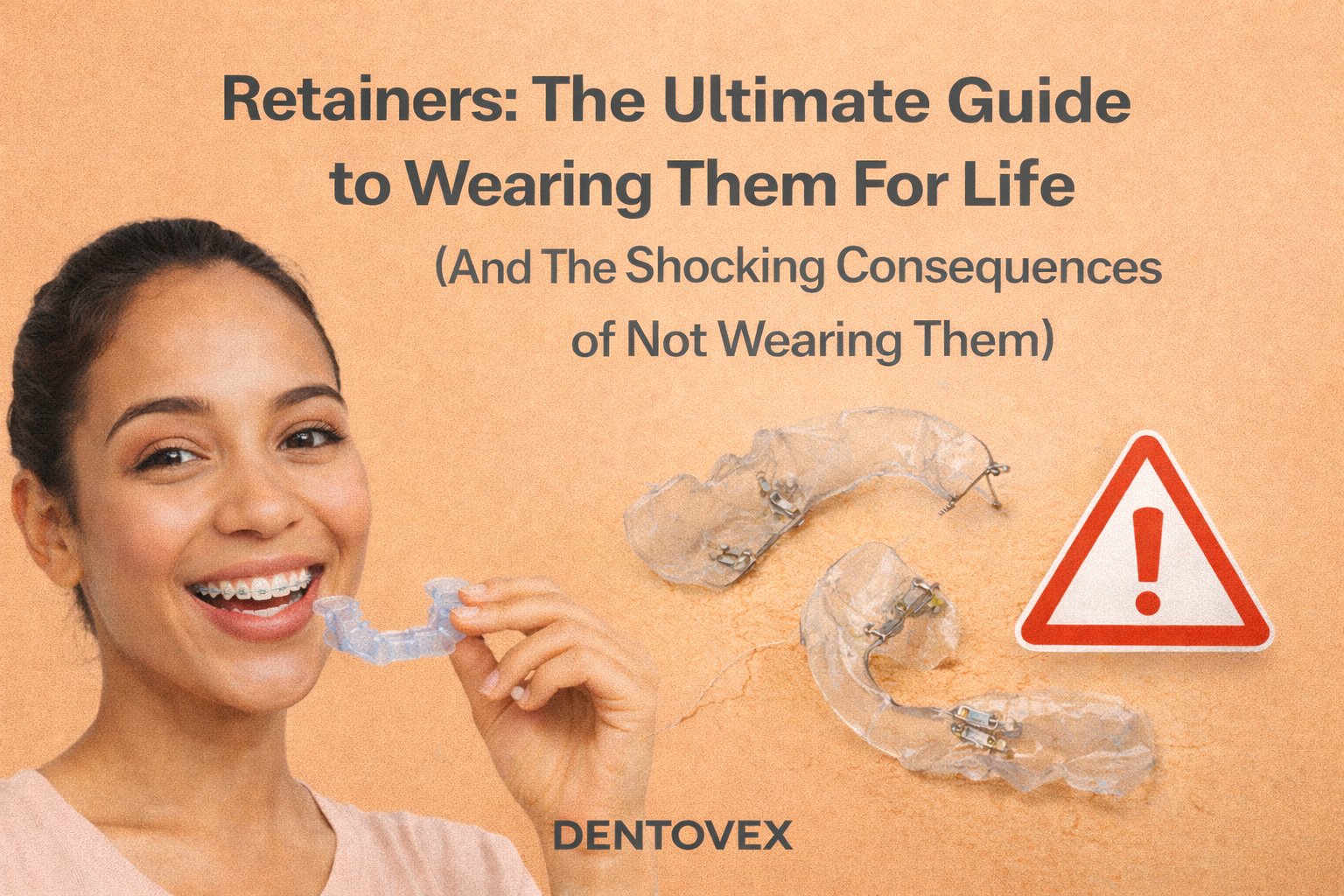
Your retainer is the only thing standing between your straight smile and that relapse. It’s not a short-term commitment; it’s the insurance policy for the time and money you invested.
At Dentovex, we stress that retainer wear is the most important part of your treatment. Here is the definitive guide on why, when, and how to wear your retainers.
1. The Science of Relapse: Why Teeth Move
To understand why you need a retainer “for life,” you need to understand the biological mechanisms behind relapse:
- The Periodontal Ligament: This network of fibers surrounds the tooth roots and is stretched during movement. When the braces are removed, these fibers contract like tiny rubber bands, pulling the teeth back. This is the most active reason for relapse in the first year.
- Facial Maturation: As you age, your jaw naturally continues to grow and change. The lower jaw tends to constrict slightly forward, leading to late-stage crowding, often around the lower front teeth. This happens even to people who never had braces!
The Two Phases of Retainer Wear
- Phase 1: Full-Time Wear (Initial Retention: 6–12 Months): Your orthodontist will likely instruct you to wear your removable retainer 22 hours a day, removing it only for eating and cleaning. This allows the bone and ligaments to stabilize around the new positions.
- Phase 2: Night-Time Wear (Long-Term Retention: Indefinitely): After the initial stabilization, you transition to wearing the retainer only at night. This commitment must continue indefinitely to counter the natural, lifelong forces of aging and drift.
2. Choosing Your Retainer: Fixed vs. Removable
Your orthodontist will recommend a retainer based on your original malocclusion and compliance level.
| Retainer Type | Description | Pros | Cons |
| Hawley (Removable) | Classic acrylic plate with a wire arch. | Durable, adjustable, easy to clean. | Visible wire, bulky, affects speech initially. |
| Essix/Vivera (Clear/Removable) | Vacuum-formed clear plastic (looks like a final clear aligner). | Invisible, comfortable, minimal speech impact. | Prone to cracking, stains easily, traps heat. |
| Fixed/Bonded (Lingual) | Thin wire permanently glued to the back of the lower (and sometimes upper) front teeth. | 100% compliant, completely invisible, always working. | Difficult to floss, requires meticulous cleaning, wire can break/pop off. |
- The Hybrid Approach: Many orthodontists recommend a fixed wire on the lower front teeth (where late-stage crowding is most common) combined with a removable Essix retainer for the upper arch.
3. The Shocking Consequences of Non-Compliance
Patients often stop wearing their retainers a few years after treatment, thinking the process is complete. The results can be devastating:
- Re-crowding: The front teeth begin to overlap again, often requiring a new, full round of braces or aligners.
- Bite Instability: If the teeth shift significantly, the perfect bite achieved during treatment is lost, potentially leading to jaw strain or TMJ discomfort.
- The Financial Toll: Having to undergo re-treatment (often costing thousands of dollars) because you skipped your retainer is a common, and completely avoidable, scenario.
The “Squeeze Test”
If your removable retainer feels tight or slightly painful when you put it in, that means your teeth have already moved. Do not force it. Wear it full-time for a few days to coerce the teeth back into position. If it still doesn’t fit after a week, call your orthodontist immediately.
4. Retainer Hygiene: Protecting Your Investment
A dirty retainer quickly becomes a magnet for bacteria and odor. Poor hygiene can lead to gum disease and cavities.
- The No-No List: Never clean your retainer with abrasive toothpaste (it scratches the plastic/acrylic). Never boil it (it warps the plastic).
- The Daily Routine: Gently brush your retainer with a soft toothbrush and non-abrasive liquid soap (e.g., clear dish soap).
- The Deep Clean: Use specialized cleaning tablets (effervescent cleaners) daily or weekly to sanitize the retainer and prevent biofilm buildup. (Reference our guide on [Best Retainer Cleaning Tablets] for product recommendations).
Conclusion: Retainers Are Your Forever Friend
Your final, straight smile is the reward for months of hard work. Your retainer is the small, final effort needed to make that investment last a lifetime. Wear it. Clean it. Treat it as your most valuable dental possession. By committing to night-time wear, you ensure your smile remains perfect forever.
Disclaimer: The decision for fixed or removable retainers, and the duration of wear, must be determined by your licensed orthodontist based on your specific case history.
Disclaimer: This article is for informational purposes only. Treatment plans for missing teeth vary highly based on bone structure. Consult a specialist for a personalized plan.
This article has been compiled and presented by Dentovex Orthodontics – Research Group for educational purposes only. It is not intended as medical advice and should not replace a face-to-face consultation with a licensed dentist, orthodontist, or other qualified healthcare professional. Always seek the advice of your own clinician regarding any questions or concerns about diagnosis, treatment, or health conditions.

No responses yet