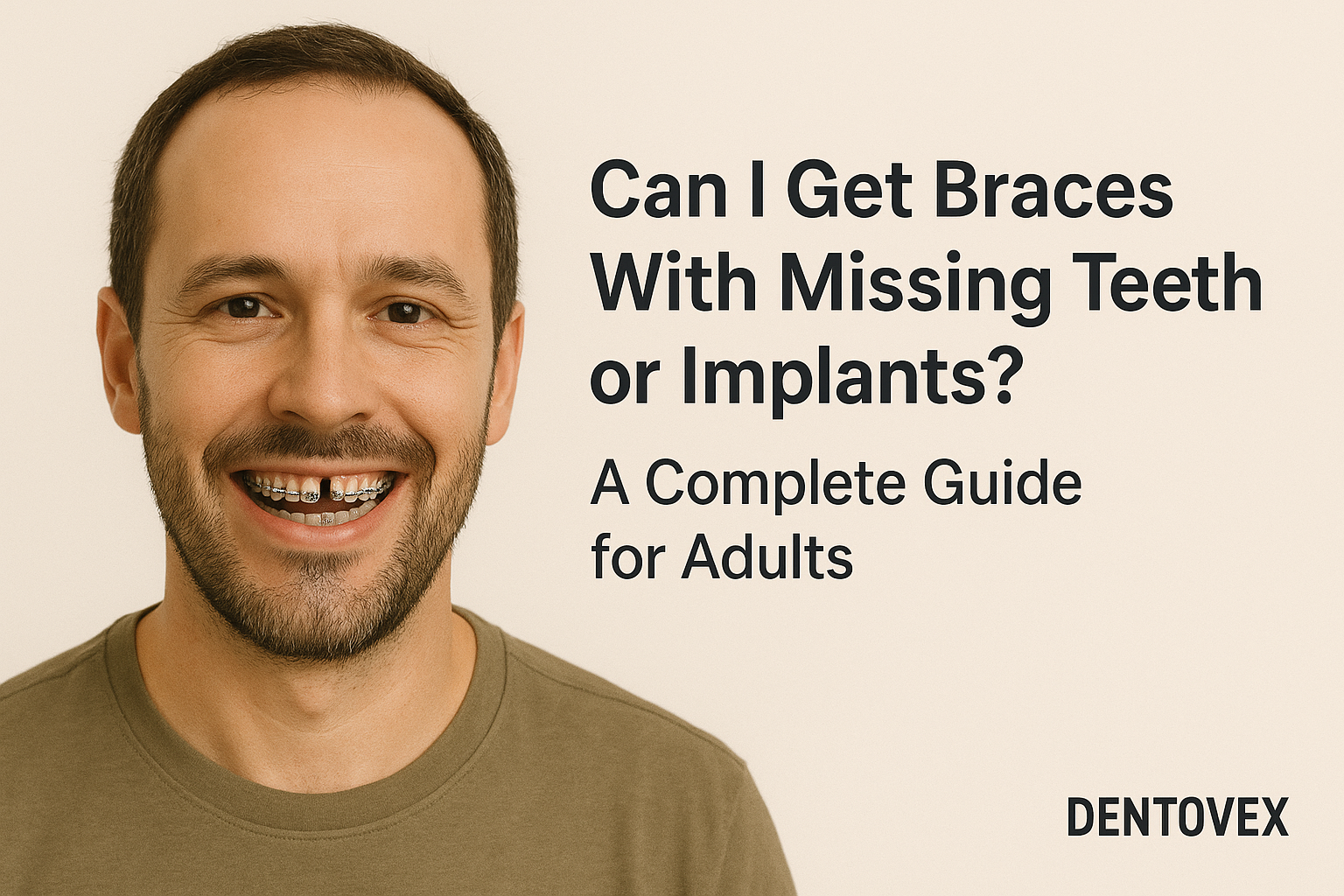
You want straight teeth. You are ready to invest in your smile. But there is a problem: You are missing a tooth.
Maybe it was extracted years ago due to decay, or maybe you were born without it (congenitally missing). Now you are wondering: “Can I even get braces? Will the wires work if there is a gap?”
The short answer is: Yes, absolutely.
In fact, orthodontics is often required to properly manage missing teeth. However, the timing is critical. If you are planning to get Dental Implants to fill that gap, you need to read this guide first. Doing things in the wrong order can cost you thousands of dollars.
At Dentovex, we help patients navigate complex restorative cases every day. Here is everything you need to know about combining braces with implants and bridges.
1. The Golden Rule: Implants Don’t Move
This is the most important rule in dentistry. Natural teeth are held in the jawbone by ligaments (like tiny rubber bands). This allows them to move when braces apply pressure. Dental Implants, however, are titanium screws fused directly to the bone (osseointegration). They are like concrete pillars. They cannot move.
What this means for you:
- Scenario A (You already have an implant): If your implant is in a bad position, braces cannot fix it. We have to move your natural teeth around the implant.
- Scenario B (You plan to get an implant): You must almost always get braces FIRST. The orthodontist will move your natural teeth into the perfect position to create the exact amount of space needed for the future implant.
2. Strategy 1: Closing the Space (No Implant Needed)
If you have a missing tooth, do you always need to replace it? Not necessarily. In some cases, especially if the mouth is crowded, we can use braces to simply close the gap.
- How it works: We use strong mechanics to pull the back teeth forward and the front teeth backward until they touch.
- The Benefit: You save thousands of dollars by not needing an implant or bridge. It’s a natural solution.
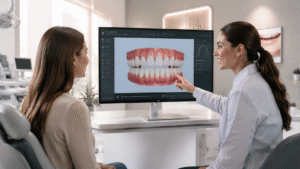
- The Risk: It takes longer, and sometimes the bone is too thin to move teeth into the gap. Your orthodontist will check your bone density with a 3D X-ray first.
3. Strategy 2: Opening the Space (Preparing for an Implant)
Sometimes, the gap is too big to close, or the neighboring teeth have drifted and tipped over into the empty space like falling dominoes.
Before a dentist can place an implant, those tipped teeth must be stood upright to make room for the screw.
- The Process: You wear braces for 12-18 months to “open” the space.
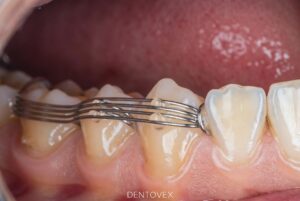
- The Transition: Once the space is perfect, your orthodontist might place a temporary “pontic” (fake tooth) on your wire so you don’t have to walk around with a gap during treatment.
- The Finish: Once braces are off, you go straight to the oral surgeon for the implant.
4. What About Bridges and Crowns?
Unlike implants, Crowns and Bridges can move, but with caution.
- Crowns: We can put a bracket on a crown, but we need special glue. Sometimes the glue damages the porcelain surface, so you might need to replace the crown after braces.
- Bridges: A bridge connects two teeth. Braces move teeth individually. Usually, your orthodontist will have to cut the bridge into sections or remove it entirely to move the supporting teeth.
5. The Cost Factor: A Major Investment
Combining orthodontics with restorative dentistry (implants) is a “Full Mouth Reconstruction.” It is expensive, but it restores your ability to chew properly for the rest of your life.
Estimated Costs (2025):
- Orthodontics: $4,000 – $7,000
- Dental Implant (per tooth): $3,000 – $5,000
- Bone Grafting (if needed): $500 – $1,500
Tip: Many dental insurance plans have separate maximums for Orthodontics and Restorative care. You might be able to use benefits from both categories.
Conclusion: A Team Effort
Fixing a smile with missing teeth is a team sport. It requires communication between your Orthodontist (who moves teeth) and your Restorative Dentist (who replaces teeth).
Don’t let a missing tooth stop you. In fact, braces might be the only way to finally fill that gap correctly.
Curious about the financial side? Revisit our comprehensive guide on Orthodontic Costs & Payment Plans to see how you can budget for this transformation.
Disclaimer: This article is for informational purposes only. Treatment plans for missing teeth vary highly based on bone structure. Consult a specialist for a personalized plan.
This article has been compiled and presented by Dentovex Orthodontics – Research Group for educational purposes only. It is not intended as medical advice and should not replace a face-to-face consultation with a licensed dentist, orthodontist, or other qualified healthcare professional. Always seek the advice of your own clinician regarding any questions or concerns about diagnosis, treatment, or health conditions.

No responses yet